Feb 23, 2026
In-House vs Outsourced Fabrication: Pros, Cons & Cost
A detailed comparison of in-house versus outsourced event fabrication covering costs, quality control, timelines, scalability, and strategic considerations for brand and agency teams.
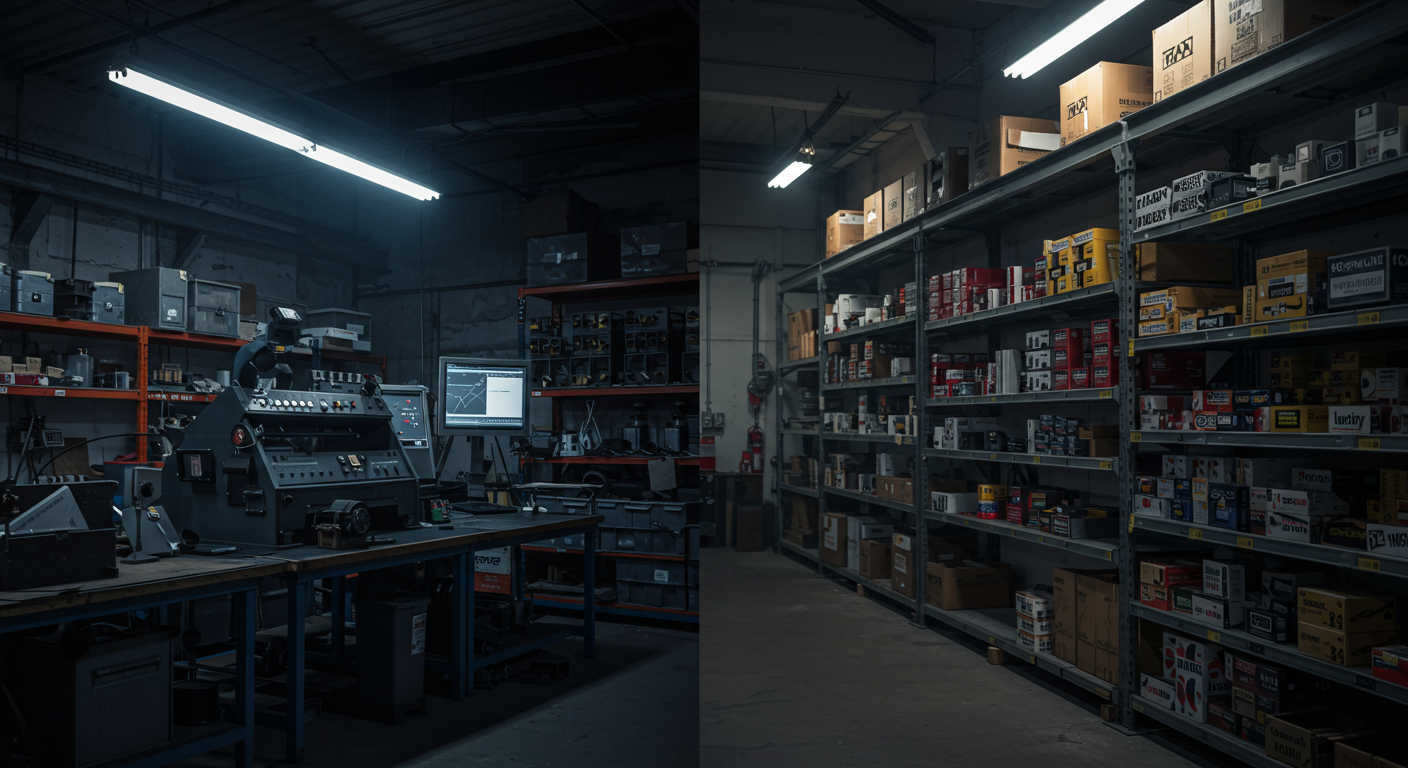
The decision between in-house fabrication and outsourced fabrication determines how brands and agencies resource the physical production of event environments, trade show exhibits, brand activations, and experiential marketing installations. Each model carries distinct advantages and limitations across cost structure, quality control, timeline flexibility, scalability, and long-term strategic positioning that must be weighed against specific organizational needs and project portfolios.
Defining the Two Models
In-house fabrication means maintaining an internal production capability — a shop space, equipment, and staff — dedicated to building event structures, signage, scenic elements, and branded environments within the same organization that designs and manages events. This model is typically found at large agencies, major brands with high-volume event programs, and dedicated fabrication companies like Pop Up Your Brand that offer integrated design-build services to external clients.
Outsourced fabrication means contracting the physical production work to an external fabrication vendor while keeping design, strategy, and project management internal. The outsourcing organization creates specifications and drawings, then sends them to one or more vendors for bidding and production. This is the predominant model for event agencies, corporate marketing departments, and production companies that lack the capital, space, or volume to justify dedicated fabrication infrastructure.
Cost Comparison
Capital and Fixed Costs
In-house fabrication requires significant capital investment. A properly equipped event fabrication shop needs industrial space (typically 5,000 to 20,000 square feet or more), CNC routers, table saws, panel saws, welding equipment, paint booths, large format printers, and dozens of smaller tools and fixtures. Combined with lease costs, insurance, utilities, and equipment maintenance, the fixed overhead for an in-house shop runs $200,000 to $800,000 or more annually before labor costs. This investment makes sense only when fabrication volume is sufficient to amortize the overhead across enough projects to achieve a lower per-project cost than outsourcing.
Outsourced fabrication converts this fixed overhead into variable cost. The fabrication vendor’s overhead is embedded in their project pricing, but the client pays only for the projects they commission. There is no shop lease during slow months, no equipment maintenance between projects, and no idle labor during gaps in the event calendar. For organizations with fewer than 15 to 20 fabrication projects per year, outsourcing almost always delivers a lower total cost of production.
Per-Project Costs
On a per-project basis, in-house fabrication can deliver 20 to 40 percent cost savings compared to outsourced production — but only when the shop is running at sufficient utilization (typically above 60 to 70 percent capacity). Below that utilization threshold, the fixed overhead distributed across fewer projects erodes the per-project advantage. Above that threshold, the margin advantage compounds because incremental projects carry minimal additional overhead.
Outsourced fabrication pricing includes the vendor’s profit margin, typically 15 to 35 percent above their direct production costs. This margin is the price of converting fixed cost to variable cost and transferring production risk to the vendor. Competitive bidding across multiple vendors can compress margins, but aggressive price competition sometimes comes at the expense of material quality, craftsmanship, or schedule reliability.
Hidden Costs in Both Models
In-house fabrication carries hidden costs that organizations frequently underestimate: equipment repair and replacement, training and certification for specialized skills (welding, electrical, CNC programming), workers compensation insurance for shop labor, waste disposal, material spoilage, and the opportunity cost of management attention devoted to production operations rather than client-facing strategy and sales. Outsourced fabrication carries its own hidden costs: project management overhead for vendor coordination, quality control travel and inspection time, shipping and logistics coordination, change-order markups, and the risk premium embedded in vendor pricing for scope uncertainty.
Quality Control
In-House Advantages
The strongest argument for in-house fabrication is quality control. When the team that designed a project also builds it, the translation from digital rendering to physical reality benefits from direct communication, shared context, and immediate feedback loops. A designer who notices a material color issue on the shop floor can address it in minutes rather than drafting an email, waiting for a response, and hoping the correction is implemented accurately at a remote facility. This proximity produces consistently tighter alignment between approved designs and finished builds.
In-house shops also develop institutional knowledge — understanding of brand standards, recurring design elements, preferred materials and finishes, and client expectations — that accumulates over multiple projects. This knowledge eliminates the ramp-up time that every new vendor engagement requires. Pop Up Your Brand’s experiential design team works directly alongside fabrication crews in the same facility, which is why PUYB maintains a track record of zero missed opens across more than 200 completed projects.
Outsourced Quality Risks
Outsourced fabrication introduces quality risk at every handoff point. Design intent must be communicated through drawings, specifications, and written instructions that the vendor’s production team interprets independently. Material substitutions — sometimes disclosed, sometimes not — affect finish quality and structural performance. Color matching across multiple vendors producing different components of the same environment is notoriously difficult. And quality problems discovered during on-site installation leave little time or recourse for corrections.
These risks are manageable with experienced vendors, clear specifications, and rigorous inspection protocols. But managing them requires project management skill and time investment that many organizations underestimate, especially when working with a new fabrication partner for the first time.
Timeline and Flexibility
In-House Speed Advantage
In-house fabrication eliminates the procurement cycle that outsourcing requires: soliciting bids, evaluating proposals, negotiating terms, issuing purchase orders, and onboarding the vendor to the specific project requirements. This administrative phase typically consumes one to three weeks before any physical production begins. An in-house team can move from approved design to production start within days, sometimes hours for urgent projects.
Mid-project changes — an inevitable reality in event production — are dramatically easier with in-house fabrication. A client request to modify dimensions, swap materials, or add elements can be communicated directly to the shop floor and implemented immediately. The same change through an outsourced vendor triggers a change order process with revised pricing, timeline impact assessment, and approval cycles that delay implementation by days.
Outsourced Scalability Advantage
Where outsourcing excels is scalability. An in-house shop has a fixed production capacity determined by its space, equipment, and headcount. When project volume exceeds that capacity — during peak event season or when multiple large projects overlap — the only options are overtime (expensive and quality-reducing), turning away work (revenue-losing), or subcontracting overflow (which negates the in-house advantage). Outsourcing provides effectively unlimited scalability because additional vendors can be engaged as volume demands. An agency managing a brand’s national event program can engage regional fabrication vendors near each venue, reducing shipping costs and enabling parallel production of simultaneous events.
Specialized Capabilities
Event fabrication spans a wide range of disciplines: carpentry, metalwork, CNC cutting, scenic painting, large format printing, LED integration, upholstery, sculpting, and more. No single in-house shop can maintain world-class capability in every discipline. Organizations that build in-house capabilities typically excel in their most common production types and outsource specialized work — complex metal fabrication, LED lighting integration, or large-scale sculptural elements — to vendors with dedicated expertise in those areas.
Conversely, a full-service fabrication partner like Pop Up Your Brand that has invested in breadth across carpentry, metal, CNC, painting, printing, and lighting under one roof offers clients the quality control benefits of in-house production across a wider range of capabilities than most organizations could justify building internally. This model — outsourcing to an integrated fabrication partner — attempts to combine the quality advantages of in-house with the variable cost structure of outsourcing.
Strategic Considerations
Core Competency Alignment
The most important question in the in-house versus outsource decision is whether fabrication is a core competency that differentiates your organization, or an operational requirement that supports your actual core competency. For a fabrication company, the answer is obvious — building is the business. For a brand marketing team or event agency, fabrication is rarely the core value proposition. These organizations typically deliver more value by focusing resources on strategy, design, audience engagement, and measurement while partnering with specialized fabrication vendors for physical production.
Intellectual Property and Confidentiality
Some brands maintain in-house fabrication specifically to protect unreleased products, proprietary display technologies, or competitive event strategies from exposure to external vendors. Product launch environments for technology, automotive, and consumer electronics companies frequently require fabrication under strict NDA and controlled-access conditions that are easier to enforce in an owned facility than at a third-party shop.
Geographic Considerations
In-house fabrication is location-bound. Shipping large, fragile event structures across the country or internationally adds significant cost and damage risk. Organizations with national or global event programs often find that a hybrid model — maintaining a core in-house capability for local markets and flagship projects while outsourcing to regional vendors for distributed events — delivers the best balance of quality, cost, and logistics efficiency.
The Hybrid Approach
Most sophisticated event organizations operate a hybrid model that leverages the strengths of both approaches. Core capabilities that directly affect quality perception — design, engineering, project management, and finishing — are maintained in-house. High-volume commodity production like standard signage and banner printing may be outsourced to cost-optimized vendors. Specialty capabilities outside the in-house range are sourced from specialist partners. And total production capacity flexes through vendor relationships that absorb overflow during peak periods.
The Monday.com MP Live project illustrates how integrated fabrication delivers results that would be difficult to achieve through a fragmented vendor approach — multiple custom environments, consistent finish quality, and tight timeline execution managed by a single accountable team from design through strike.
Making the Decision
The in-house versus outsourced fabrication decision ultimately depends on annual project volume, production complexity, quality requirements, capital availability, and strategic priorities. Organizations with fewer than 15 projects annually, variable production types, and limited capital should outsource to a qualified fabrication partner. Organizations with consistent high volume, standard production types, and the capital and management bandwidth to operate a production facility may benefit from building in-house capability. And most organizations will find that the optimal answer is a hybrid that matches the right production model to each project type within their portfolio.
Whatever the model, the critical success factor remains the same: the physical production of event environments demands expertise, precision, and accountability. Whether that expertise lives inside your organization or at a trusted fabrication partner, investing in production quality pays dividends in brand perception, audience experience, and event performance that far exceed the cost difference between production models.
Recent work like the Celsius Pop-Up and the Keurig × Nasdaq activation reflects the in-house fabrication standards Pop Up Your Brand brings to every build.