Feb 16, 2026
LED Lighting for Events: Integration, Design & Cost Guide
A technical guide to LED lighting for events covering fixture selection, integration methods, color design, power requirements, and cost planning for brand activations and trade shows.
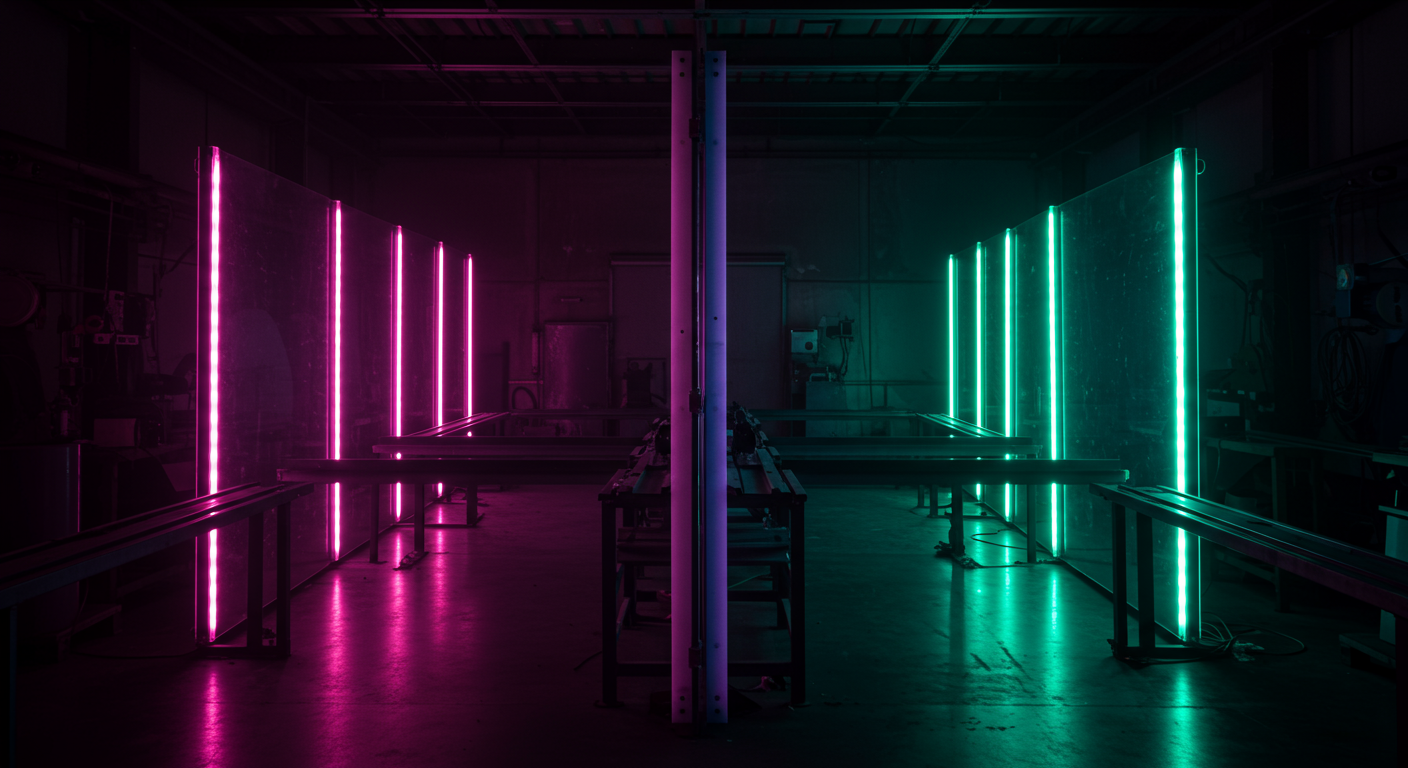
LED lighting for events is the practice of using light-emitting diode technology to illuminate, brand, and transform physical spaces for trade shows, brand activations, corporate gatherings, and experiential marketing installations. Modern LED fixtures offer programmable color, low heat output, minimal power draw, and compact form factors that make them the dominant lighting technology for fabricated event environments across virtually every industry and venue type.
Why LED Dominates Event Lighting
The shift from conventional incandescent and halogen fixtures to LED technology in events has been driven by measurable performance advantages. LED fixtures consume 75 to 85 percent less power than equivalent incandescent sources, which directly reduces generator costs for outdoor activations and temporary power requirements for convention halls. Heat output drops proportionally, which matters enormously inside enclosed fabricated structures, pop-up retail environments, and branded enclosures where air conditioning capacity is limited and guest comfort is critical.
Color flexibility is the other transformative advantage. A single RGBW LED fixture can produce millions of color combinations, allowing event designers to match precise Pantone brand colors, shift palettes between program segments, and create dynamic lighting sequences synchronized with music or presentations. This eliminates the need for gel filters, reduces fixture counts, and gives creative teams real-time control over the visual atmosphere of an entire environment.
Lifespan and reliability round out the case. Quality LED fixtures rated at 50,000 hours of operation virtually eliminate lamp failures during multi-day events. For touring activations that visit dozens of cities, this reliability translates directly into reduced maintenance costs and eliminated show-stop risks from burned-out lamps at critical moments.
LED Fixture Types Used in Event Fabrication
Selecting the right fixture type for each application is the foundation of effective LED lighting integration. Event fabrication professionals work with several distinct categories, each suited to specific roles within a built environment.
LED Strip and Tape Lights
Flexible LED strip lights are the most versatile fixture category in event fabrication. Available in single-color, tunable white, RGB, and RGBW configurations, strips can be cut to precise lengths and mounted on virtually any surface. Common applications include edge-lighting acrylic panels and signage, cove lighting inside architectural reveals and soffits, backlighting translucent fabric walls, outlining dimensional brand elements, and creating continuous linear accents along counters, shelving, and architectural features. High-density strips with 60 or 120 LEDs per meter deliver smooth, dot-free illumination suitable for close-viewing distances. Waterproof IP65-rated strips handle outdoor installations and environments where spills are possible.
LED Par Cans and Wash Fixtures
LED par cans remain the workhorse of general event lighting. Modern RGBW pars produce broad, even washes of color for uplighting walls, flooding backdrops, and establishing ambient room color. Battery-powered wireless pars have revolutionized event lighting by eliminating cable runs entirely — critical in venues where running power cables across floors creates tripping hazards or violates fire codes. Professional-grade wireless pars offer eight to twelve hours of battery life, DMX and wireless DMX control, and magnetic mounting options for quick repositioning during events.
LED Panels and Video Walls
Direct-view LED panels have evolved from exclusively large-format stadium displays into a practical lighting and content surface for event fabrication. Fine-pitch panels with pixel spacings of 2.5 millimeters or less deliver high-resolution imagery visible at close range, making them suitable for trade show booths, retail environments, and intimate brand activations. When integrated into fabricated walls, counters, or overhead structures, LED panels serve double duty as both dynamic content displays and ambient lighting sources. The ability to display video, animated graphics, data visualizations, and solid brand colors on the same surface provides creative flexibility that no static medium can match.
LED Neon Flex
Silicone-jacketed LED neon flex tubing replicates the aesthetic of traditional glass neon without the fragility, high voltage, or custom bending lead times. Available in a wide range of colors and bendable to tight radii, LED neon flex is ideal for dimensional signage, branded lettering, decorative outlines, and artistic installations. Pop Up Your Brand regularly integrates LED neon flex into fabricated brand walls, photo-opportunity backdrops, and retail display environments where the warm glow of neon adds visual texture and social-media-friendly appeal.
Architectural and Effect Fixtures
Specialized LED fixtures handle specific creative requirements. LED pixel tubes and kinetic fixtures create three-dimensional lighting sculptures and ceiling installations. Gobo projectors with LED sources project logos and patterns onto walls, floors, and ceilings. Blacklight and UV LED fixtures activate fluorescent paints and materials for immersive environments. Each of these specialty categories opens creative possibilities that would be impractical or impossible with conventional lighting technology.
Integration Methods for Fabricated Environments
The technical challenge in event LED lighting is not selecting fixtures — it is integrating them seamlessly into fabricated structures so that the light appears intentional and the hardware disappears. This integration work is where professional event fabrication distinguishes itself from basic AV rental.
Concealed Channel Mounting
Aluminum channels with diffuser lenses mount LED strips inside fabricated walls, counters, and architectural elements. The channel provides a heat sink that extends LED lifespan, while the diffuser eliminates visible hot spots and creates smooth, continuous lines of light. Channels are routed into substrates during fabrication so they sit flush with finished surfaces, making the light source invisible while the illumination effect is prominent.
Backlit Panel Construction
Backlit panels combine a translucent face material — typically fabric, acrylic, or polycarbonate — with an array of LED strips or edge-lighting positioned behind the surface. Uniform backlighting across large surfaces requires precise spacing calculations. For edge-lit applications, laser-etched light guide panels distribute light from edge-mounted strips across the full panel area. These techniques produce the luminous branded walls and glowing product displays that define premium trade show booths and brand activation environments.
Structural Integration
For immersive environments and large-scale installations, LED fixtures are integrated directly into the structural framing during the fabrication process. Wiring is routed through wall cavities and conduit before surfaces are applied. Junction boxes and quick-connect plugs are positioned for rapid on-site assembly. This approach keeps all wiring concealed, ensures code compliance, and dramatically accelerates load-in because lighting installation happens simultaneously with structural assembly rather than as a separate phase.
Color Design and Brand Matching
Achieving accurate brand colors with LED lighting requires understanding the relationship between emitted light color and perceived surface color. A red LED washing a white wall will render differently than the same LED washing a gray or textured surface. Professional lighting designers test color rendering on the actual materials and finishes specified for the build, adjusting fixture output, distance, and angle to achieve the closest possible match to approved brand colors.
Color temperature consistency across a fabricated environment is equally important. Mixing LED fixtures from different manufacturers or product lines often introduces visible color temperature variation — warm and cool zones that undermine the cohesive look of a premium build. Specifying all white-light fixtures from the same product family and same manufacturing batch minimizes this risk. For critical brand color applications, PUYB sources matched fixture lots and conducts pre-production color calibration in the shop before anything ships to a venue.
Power Planning and Distribution
LED lighting’s low power consumption is an advantage, but it does not eliminate the need for careful electrical planning. A large-scale activation with hundreds of linear feet of LED strips, dozens of par cans, and multiple LED panels still requires dedicated circuits, properly rated power supplies, and clean electrical distribution.
LED strips operate on low-voltage DC power, typically 12V or 24V, supplied by driver units that convert AC line power. Driver sizing must account for the total connected LED load plus a 20 percent safety margin. Long runs of LED strips experience voltage drop — a progressive dimming toward the far end of the run — which is managed by limiting run lengths, using higher-voltage 24V strips, or injecting power at multiple points along the run. These technical details are invisible to event attendees but directly affect the visual quality of the finished installation.
For temporary event installations, power distribution must also comply with local electrical codes and venue regulations. Licensed electricians may be required for connections to venue power. Generator-powered outdoor events need clean sine-wave power output to avoid LED flicker and driver damage. All of these requirements are part of the production planning that Pop Up Your Brand manages as part of integrated LED lighting integration services.
DMX Control and Programming
DMX512 is the standard control protocol for professional event lighting. A single DMX universe controls up to 512 channels, with each LED fixture consuming between one and dozens of channels depending on its feature set. Modern LED installations for events typically use wireless DMX transmitters to eliminate control cable runs, networked Art-Net or sACN protocols for large installations spanning multiple DMX universes, and pre-programmed lighting scenes stored on standalone controllers for unattended operation during multi-day events.
Programming time is a cost factor that clients frequently underestimate. A complex immersive environment with dozens of independently controlled lighting zones, color-changing sequences, and triggered effects can require eight to sixteen hours of on-site programming after physical installation is complete. Building programming time into the load-in schedule prevents last-minute compromises on lighting design.
Cost Factors for LED Lighting in Events
LED lighting costs for events break down into fixture hardware, power supplies and control equipment, integration labor during fabrication, programming, and on-site installation. A simple branded backdrop with integrated LED edge-lighting might add $1,500 to $4,000 to the fabrication budget. A fully lit trade show booth with backlit walls, accent lighting, and programmable color zones typically runs $8,000 to $25,000 for lighting components and integration. Large-scale immersive activations with LED video panels, pixel-mapped ceiling installations, and multi-zone color control can reach $50,000 to $150,000 or more for the lighting package alone.
Rental versus purchase decisions affect cost significantly. For one-time events, renting LED panels and high-value fixtures reduces capital outlay. For touring activations that visit multiple cities, purchasing fixtures and integrating them permanently into the fabricated structure delivers lower per-event costs. The Celsius Pop-Up project exemplifies this approach, with LED lighting designed and built into the modular structure for consistent brand presentation across a nationwide tour.
Common Mistakes and How to Avoid Them
Several recurring mistakes undermine LED lighting quality in event fabrication. Insufficient diffusion creates visible LED dots and hot spots on surfaces that should appear uniformly illuminated. Mismatched color temperatures across fixture types produce inconsistent warm and cool zones. Undersized power supplies cause dimming, flicker, or complete fixture failure under load. Ignoring voltage drop on long LED strip runs creates visibly uneven brightness. Omitting programming time from the production schedule forces rushed or incomplete lighting execution on-site.
Each of these issues is preventable through proper planning, specification, and testing during the fabrication phase — before anything arrives at the venue. Shop testing of all lighting systems in their fabricated housings is a standard practice at PUYB that catches these problems when corrections are straightforward rather than at the venue where every hour of delay costs money.
Choosing the Right Lighting Integration Partner
The most effective approach to LED lighting for events is to work with a fabrication partner that handles lighting integration as part of the build process rather than as a separate subcontracted scope. When the fabrication team designs, engineers, and installs the lighting concurrently with the structural build, every channel, pocket, and power connection is planned from the start. This integrated approach eliminates the coordination gaps, schedule conflicts, and finger-pointing that arise when structural fabrication and lighting installation are managed by separate vendors with separate timelines.
LED lighting transforms event environments from static physical structures into dynamic branded experiences. Whether the project calls for subtle accent lighting on a product display or a fully immersive color-saturated environment, understanding fixture types, integration methods, power requirements, and cost factors enables smarter planning and better results. The technology is mature, affordable, and endlessly flexible — success depends on the quality of integration and the expertise of the team executing it.
Recent work like the Tao Group × Moxy Hotel installation and the Magic Hour Mountain Lodge at Moxy NYC reflects the in-house fabrication standards Pop Up Your Brand brings to every build.