May 23, 2026
Outdoor Brand Activation Builds: A Weatherproofing Guide
How experiential teams engineer outdoor brand activations to survive wind, rain, heat, and ground—ballast, materials, sealing, and fast assembly.
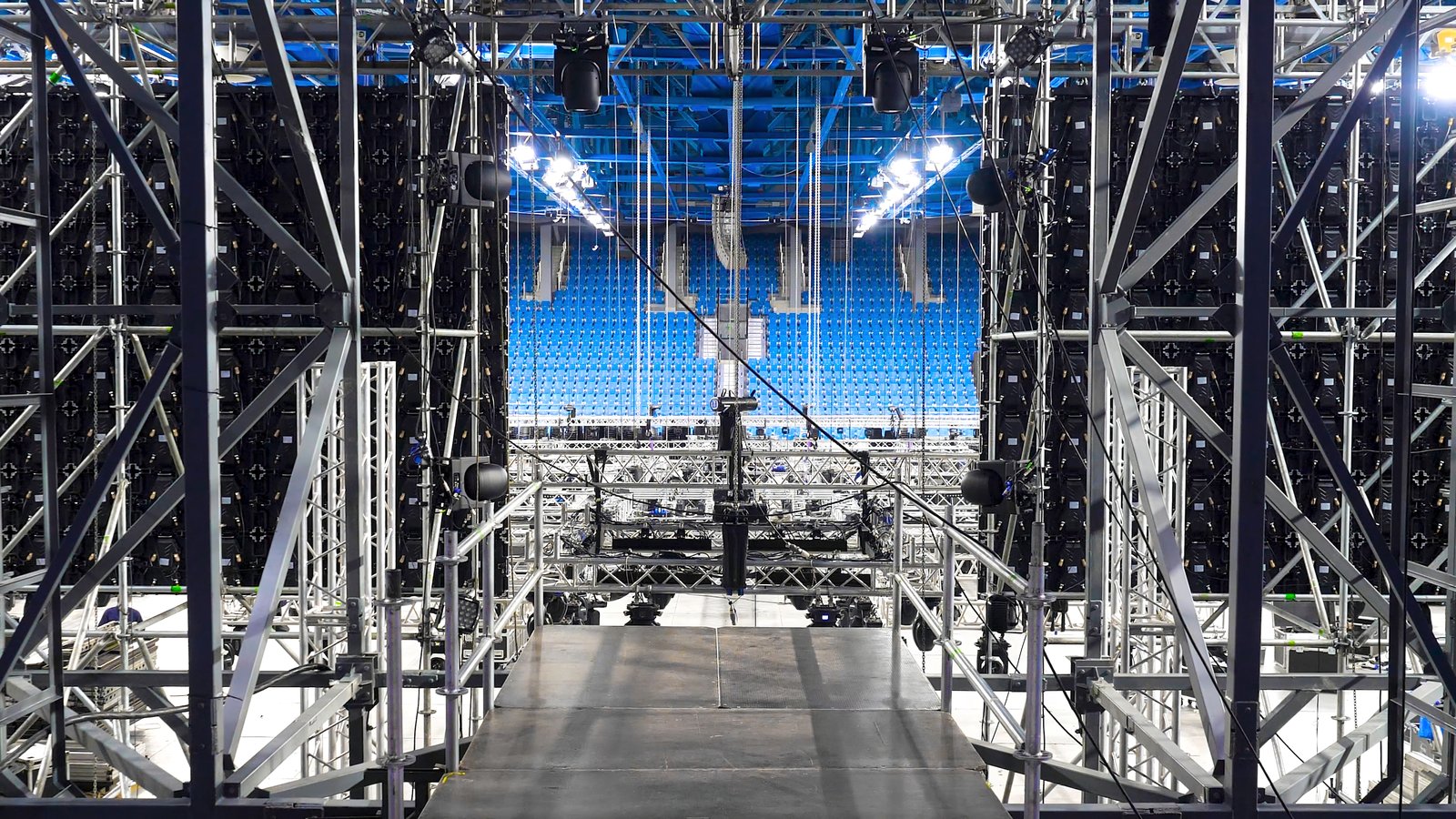
An outdoor brand activation lives or dies by the weather it was built to ignore. A booth on a convention floor only has to survive HVAC and foot traffic. A footprint in a park, a parking lot, a festival field, or a Manhattan plaza has to survive a 40 mph gust off the river, an afternoon downpour, eight hours of direct UV, and an overnight temperature swing — sometimes all in the same day. The structures that hold up are not the prettiest renders. They are the ones engineered for load, drainage, and disassembly from the first sketch. This guide breaks down how serious fabrication teams build outdoor activations that read flawless on camera and stay standing through the forecast, drawing on the way we approach open-air builds when the venue has no roof, no climate control, and no second chances.
The Four Forces Every Outdoor Build Fights
Indoors, a fabricated environment answers to gravity and the occasional clumsy attendee. Outdoors, four forces are working against the build at all times: wind, water, temperature, and ground. Wind wants to lift, slide, or tip anything with a face. Water wants to pool on flat surfaces, wick into seams, and short out electronics. Temperature cycles expand and contract materials, warp panels, and fade finishes. And the ground — turf, asphalt, brick pavers, a flatbed of plywood over a curb — dictates how, and whether, you can anchor at all.
The mistake most teams make is treating weatherproofing as a finishing step — a tarp thrown over a structure designed for a ballroom. It is not a finish. It is a design constraint that sits next to the creative brief from day one. Every decision downstream, from panel material to footing detail to the order in which the crew bolts things together on site, flows from how the build answers those four forces.
Wind Is the First Engineering Problem
Wind is the force that turns a beautiful activation into a liability and a news story. The physics is simple and unforgiving: any vertical surface is a sail, and the load it catches scales with the square of wind speed. Double the wind, quadruple the force. A 10′ x 10′ branded wall in a 30 mph gust can catch well over a thousand pounds of lateral push. That load has to go somewhere — into ballast, into anchors, or into the ground — or the wall goes over.
The first lever is surface area. Solid walls are sails; mesh banners, perforated panels, and open-frame structures bleed air through and shed load. When a hero wall has to be solid for the brand, we cut its effective sail by raising it off grade so wind passes underneath, by breaking a long run into staggered segments, or by specifying a wind-rated tension-fabric face that flexes instead of fighting. The same structural discipline that goes into our stage and scenic fabrication — where a backdrop has to stand tall and dead-flat under house wind and rigging loads — carries straight over to an open-air footprint.
The second lever is ballast. When you cannot drive a stake — and on asphalt, pavers, or a permitted plaza you usually cannot — you hold the structure down with weight. The table below is a planning starting point, not a stamped engineering calculation; every real build gets run by a licensed engineer when the structure or the permit demands it.
| Element | Typical exposed face | Ballast planning rule of thumb |
|---|---|---|
| Freestanding 8′ branded wall | ~80–100 sq ft | 250–400 lb per support leg, low and wide |
| 10′ x 20′ open-frame canopy | Roof uplift dominates | 500+ lb per leg; cross-bracing mandatory |
| Backlit arch / entry portal | Tall, narrow, top-heavy | Weighted base plates + guy lines if permitted |
| Hanging banner / mesh sign | Variable; mesh sheds load | Rated truss + counterweight per rigging plan |
The third lever is the take-down trigger. Every outdoor activation needs a written wind action plan: a speed at which staff stop the event, a speed at which they drop banners and secure loose elements, and a speed at which the structure comes down entirely. Anemometer on site, numbers agreed with the producer and the venue, no judgment calls in the moment. Building that plan into the experiential design phase — not the morning of — is the difference between a controlled strike and an emergency.
Designing for Water Before It Rains
Water does three things to an outdoor build, and all three are preventable at the fabrication stage. It pools on flat horizontal surfaces and adds dead load no one budgeted for. It wicks into seams, raw MDF edges, and unsealed end-grain, swelling and delaminating panels overnight. And it finds the lowest electrical connection and shorts it.
The fixes are old-school carpentry and detailing, not magic coatings. Pitch every horizontal surface a minimum of a quarter-inch per foot so water runs off instead of ponding. Detail drip edges on overhangs so runoff sheds clear of the face graphic rather than streaking down it. Specify marine-grade or exterior-rated substrates — high-density polyethylene, exterior plywood, aluminum composite panel, powder-coated steel — anywhere weather touches, and seal every cut edge, because a panel is only as waterproof as its worst-sealed corner. Raise everything off grade on feet or a sub-deck so the structure is never sitting in a puddle. These are the same substrate and finish decisions we make across our broader event fabrication services, just pushed to the exterior-rated end of the spec sheet.
Outdoors, a build is only as waterproof as its worst-sealed edge and only as stable as its lightest-loaded leg. The weakest detail sets the rating for the whole structure.
Graphics deserve their own water plan. Direct-print on a porous substrate will bleed and lift. The durable path is dye-sublimated tension fabric, UV-cured print on rigid exterior board, or vinyl with a laminate overlay rated for outdoor exposure. When a client wants the saturated, lit-from-within look that reads on camera, we move the graphic into a sealed light box rather than gambling on a backlit fabric staying crisp through a storm.
Heat, UV, and Cold: Materials That Hold Their Finish
A single summer afternoon in an open lot will do more to a finish than a month indoors. Direct sun fades unrated inks and pigments, softens adhesives until vinyl creeps, and heats dark surfaces past the point where they are safe to touch. Cold and humidity swing the other way overnight, contracting joints and condensing moisture inside electronics enclosures. The build has to tolerate the full daily cycle, not just the photo at golden hour.
The material answers are specific. Choose UV-stable inks and powder-coat finishes over solvent paints that chalk. Avoid large unbroken dark panels in full sun, or back them with a substrate that will not warp when one face is 40 degrees hotter than the other. Allow expansion gaps at panel joints so a 20-foot run does not buckle at 2 p.m. Spec adhesives and tapes by their service-temperature range, not by what was on the shelf. The comparison below is how we think about substrate selection when the activation has to survive a full outdoor cycle.
| Material | Outdoor behavior | Best use |
|---|---|---|
| Aluminum composite panel | Stable, won’t absorb water, sheds heat | Hero faces, logo walls, signage |
| High-density polyethylene | Waterproof, UV-tolerant, takes routing | Counters, low walls, ground-contact parts |
| Exterior plywood (sealed) | Strong, economical; fails fast if edges go raw | Hidden structure, sub-decks, framing |
| Powder-coated steel / aluminum | Excellent; corrosion-resistant if coated | Frames, legs, ballast brackets, arches |
| Dye-sub tension fabric | Flexes in wind, dries fast, packs small | Large graphic faces, soft architecture |
Ground Conditions and Anchoring Without Penetration
The single biggest variable on an outdoor site is what you are standing on, and it is the one most often discovered too late. Turf takes stakes and screw anchors and is forgiving — until it rains and the field turns soft. Asphalt and concrete will not let you penetrate without a permit and a patch obligation, so the structure has to hold itself down with ballast. Brick and stone pavers in a plaza usually cannot be touched at all, and the venue will inspect the footprint before and after. Decking, curbs, and uneven grade demand leveling feet and shims so the build does not rock.
This is why a site survey is non-negotiable before fabrication locks. We want to know the surface, the slope, the overhead clearance, the access path for the truck, and where the load-in dock or curb cut actually is. A footprint that assumes flat asphalt and arrives to find a 3-degree slope and cobblestone is a footprint that gets rebuilt on site at 5 a.m. Our work on activations like the Celsius pop-up and high-traffic public placements is built around leveling and ballast systems that adapt to whatever the ground turns out to be, because the renders never match the curb.
Power, Lighting, and Electronics in the Open Air
Outdoor power planning is where activations quietly fail. The grid you imagined is rarely there; you are running off a generator or a single 20-amp circuit shared with a coffee cart. Every connection that touches weather needs to be a sealed, weather-rated coupler, every cable run needs to be matted or ramped so it neither trips guests nor sits in a puddle, and every enclosure for a media player or controller needs a gasket and a drip loop so condensation drains away from the electronics. Twilight and night activations lean hard on lighting, and that lighting hardware has to carry the same exterior rating as everything else.
When the experience is screen-driven or interactive, the bar rises again. LED walls, projection, and sensor-driven moments need shade hoods to stay legible in daylight, ventilation to stay cool, and a clean power profile to stay synced. That integration of structure, content, and hardware is the heart of immersive production, and outdoors it means the enclosure is engineered around the technology rather than the technology being crammed into a box at the end. The activation we built for Keurig at Nasdaq is a reminder that a screen-forward moment is only as good as the housing that keeps it running.
Build for the Truck, Not Just the Render
An outdoor build has to survive two journeys: the weather, and the road. A structure that is gorgeous in the shop but takes nine hours and a forklift to stand up will blow the load-in window, and outdoor load-in windows are tight, weather-dependent, and expensive to miss. The fix is modularity. Design the build as a kit of repeatable, truck-friendly modules that bolt or pin together, that two crew can carry, and that pack into a known number of road cases or a single box truck.
Modular thinking pays off three times: faster, safer assembly on a clock; the ability to strike fast when the wind plan says so; and reuse across multiple market stops without rebuilding from scratch. This is the same engineering logic behind our trade show fabrication, where exhibits are designed to ship, assemble, and break down on a strict schedule across a season. A touring outdoor activation is a trade show booth that also has to fight the sky. Connection details matter here: captive hardware so nothing gets dropped in the grass, color-coded or numbered parts so an unfamiliar local crew can build it, and a strike sequence documented as carefully as the build sequence.
Retail Footprints Need the Same Discipline
Selling outdoors raises the stakes again, because now the build holds product, cash, and a brand experience that has to reset clean every morning. A weekend pop-up shop design placed in a plaza or parking lot needs fixtures that lock down, merchandising that will not blow off a shelf, sealed storage for stock, and a structure that closes up secure and weather-tight overnight. The same controlled-environment discipline that made the build for the Magic Hour Mountain Lodge at Moxy NYC work as a repeatable, season-long destination is what lets an outdoor retail footprint open and close cleanly day after day without degrading.
Permits, Wind Ratings, and the NYC Paper Trail
In New York City and most dense metros, an outdoor structure above a certain size or height is not just a creative object — it is a temporary structure subject to permits, and increasingly to a stamped engineering review for wind and stability. Tents over a threshold square footage, anything people stand under, and any structure anchored into public ground will draw a closer look from the venue, the parks department, or the buildings department. The activation can be flawless and still get shut down at 9 a.m. for missing a wind-load letter.
The way to win that fight is to build the paperwork into the timeline alongside the build. Know early whether the structure needs a professional engineer’s stamp. Have the ballast and anchoring plan documented, not improvised. Carry the certificate of insurance, the flame-spread certifications for fabrics, and the wind action plan in a binder on site. Treat the convention-center and municipal load-in rules as design inputs, the same way an indoor exhibitor treats a hall’s rigging and fire code. Activations like Café de Colombia at the San Diego Convention Center succeed in part because the compliance work is treated as part of fabrication, not an afterthought handed to the producer.
A Pre-Build Weatherproofing Checklist
Before any outdoor activation leaves the shop, run it against this list. If any line is unanswered, the build is not ready to load.
- Wind: Sail area calculated, ballast or anchoring specified per leg, and a written wind action plan with stop/secure/strike speeds.
- Water: Horizontal surfaces pitched to drain, all cut edges sealed, structure raised off grade, graphics on exterior-rated media.
- Heat & UV: UV-stable inks and finishes, expansion gaps at joints, no unbroken dark panels baking in full sun.
- Ground: Site survey complete — surface, slope, clearance, and truck access confirmed; leveling feet on board.
- Power: Weather-rated connectors, gasketed enclosures with drip loops, cable matting, generator plan and load budget.
- Transport: Modular kit packs into a known case count, two-person handling, numbered parts, documented build and strike sequence.
- Compliance: Engineering stamp if required, ballast plan documented, COI and flame-spread certs on site.
Build It to Survive the Forecast
Outdoor activations are the highest-reward, highest-risk format in experiential. Done right, they put a brand in front of people in real space, in real weather, with nothing between the audience and the work. Done without engineering discipline, they are a fade, a flood, or a fall waiting for a gust. The brands that win outdoors are the ones whose fabrication partner treated wind, water, temperature, ground, power, transport, and permits as design constraints from the first conversation — not as problems to solve in the parking lot at dawn.
If you have an outdoor footprint on the calendar — a festival, a plaza takeover, a parking-lot launch, a touring activation across markets — bring the build to a team that quotes lead times in business days and material specs in inches. Tell us the site, the season, and the creative ambition, and we will engineer it to stand. Start a conversation about your next outdoor brand activation and we will pressure-test the plan against the forecast before a single panel gets cut.