Mar 02, 2026
Trade Show ROI: How to Measure Exhibit Performance
A comprehensive guide to measuring trade show ROI covering lead capture, brand impressions, cost-per-lead benchmarks, and revenue attribution frameworks for exhibit performance.
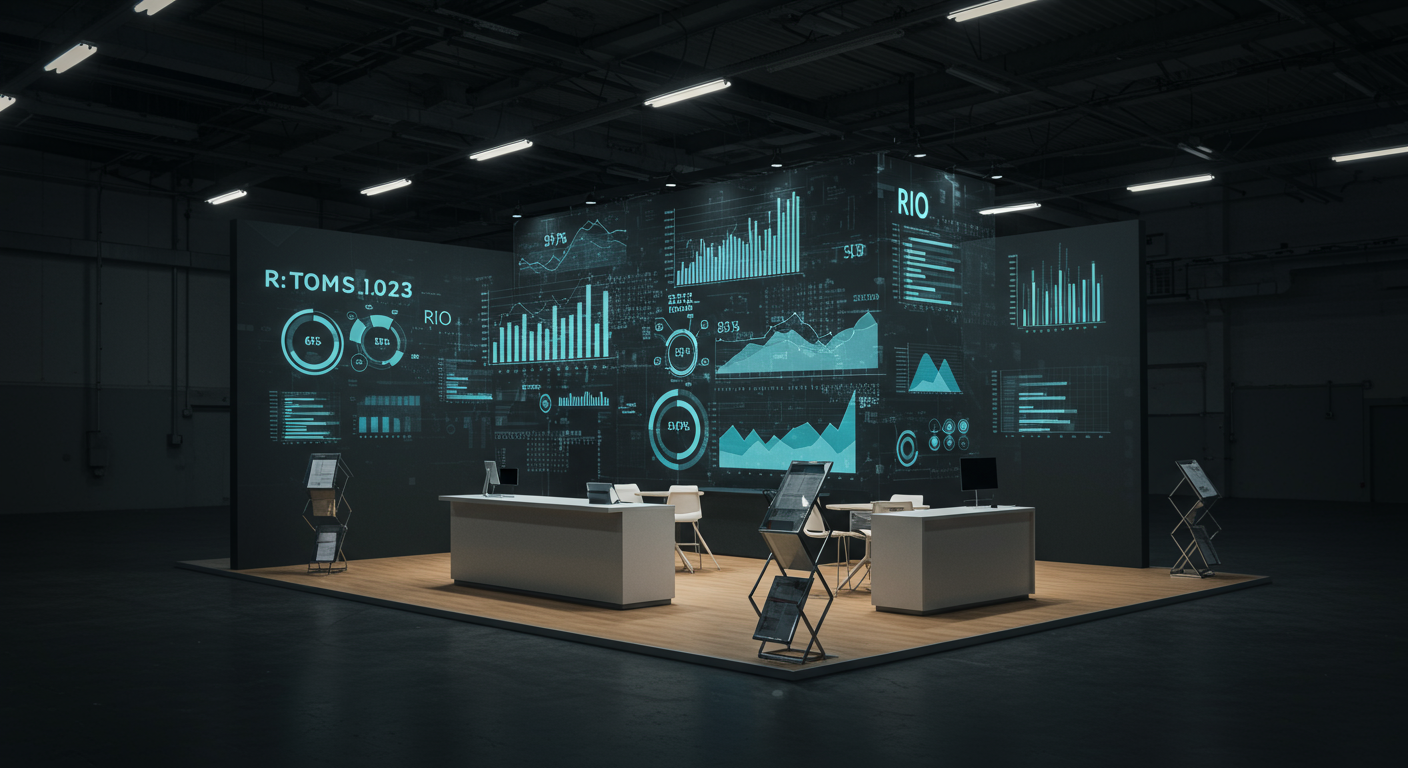
Trade show ROI measures the quantifiable return generated by an exhibit investment, expressed as a ratio of revenue or business value gained against total costs incurred for booth design, fabrication, logistics, staffing, and show services. Accurately calculating trade show ROI requires a structured framework that captures both direct revenue outcomes and indirect brand-building value across the full sales cycle following an event.
Why Trade Show ROI Measurement Matters More Than Ever
Trade shows remain one of the highest-investment marketing channels for B2B and B2C brands alike. A single major trade show exhibit can cost anywhere from $50,000 to $500,000 or more when factoring in booth design and trade show fabrication, shipping, drayage, show services, travel, accommodations, staffing, and promotional materials. Despite these costs, many exhibitors still rely on anecdotal feedback rather than structured ROI analysis to evaluate performance.
The consequence of that gap is significant. Marketing budgets face increased scrutiny from leadership teams that demand measurable results from every channel. Without concrete ROI data, trade show programs become vulnerable to cuts during budget tightening — even when they are generating substantial pipeline and revenue. Companies that implement rigorous ROI measurement consistently outperform peers by reallocating resources toward higher-performing shows and optimizing booth design, staffing, and follow-up strategies based on actual data rather than gut feeling.
The Complete Trade Show ROI Formula
The foundational ROI formula is straightforward: subtract total trade show costs from total revenue attributed to the show, divide by total costs, and multiply by 100 to get a percentage. However, the simplicity of this formula belies the complexity of accurately capturing both sides of the equation.
Calculating Total Trade Show Costs
A comprehensive cost accounting must include every expense category. Booth design and fabrication costs encompass the initial design phase, custom exhibit design and engineering, materials and construction, finishing and graphics, and any rental components. Logistics costs include outbound and return freight, drayage (the cost of moving your exhibit from the loading dock to your booth space and back), material handling, and storage. Show services cover electricity, internet, lead retrieval systems, carpet and padding, rigging, and any labor ordered through the venue or general contractor.
Staffing costs include travel, accommodations, meals, per diem, and the opportunity cost of pulling sales and marketing team members from their regular activities. Pre-show marketing encompasses direct mail, email campaigns, social media promotion, paid advertising targeting attendees, and any sponsored speaking sessions or event sponsorships. On-site expenses cover branded giveaways, catering and hospitality, AV equipment, and any entertainment or demonstration materials.
A common mistake is excluding indirect costs like pre-show marketing, staff opportunity cost, and post-show follow-up resources. These costs are real and substantial, and excluding them inflates apparent ROI while masking the true cost of the trade show channel.
Measuring Revenue Attribution
The revenue side of the equation is where most ROI calculations fall apart. Trade shows rarely generate immediate point-of-sale transactions for B2B companies. Instead, they produce leads that enter a sales cycle lasting weeks, months, or even years. Accurate revenue attribution requires tracking every lead captured at the show through the complete sales funnel to closed revenue.
Implement a multi-touch attribution model that assigns appropriate credit to the trade show touchpoint within the broader buyer journey. First-touch attribution gives the trade show full credit if it was the initial point of contact. Last-touch attribution credits the trade show only if it was the final touchpoint before a deal closed. Multi-touch attribution distributes credit proportionally across all touchpoints — the most accurate model but also the most complex to implement.
The CRM integration is essential. Every lead scanned or collected at the show must be entered into the CRM with a source tag identifying the specific trade show. Sales teams must maintain this tagging discipline through the entire pipeline so that revenue from show-sourced leads can be tracked to closure. Without this discipline, ROI measurement becomes guesswork.
Key Performance Indicators Beyond Revenue
Revenue attribution captures only part of the trade show value proposition. A comprehensive ROI framework includes several additional KPIs that quantify brand-building, relationship-development, and market-intelligence value.
Lead Volume and Quality Metrics
Total leads captured is the most basic metric but must be segmented by quality tier. Implement a lead scoring system that categorizes contacts captured at the show into hot leads (active buying intent, budget authority, defined timeline), warm leads (interest expressed but no immediate buying trigger), and informational contacts (gathered information but no apparent buying intent). The ratio of hot and warm leads to total leads is a critical quality indicator that reflects both your targeting strategy and your booth team’s qualification skills.
Cost per lead (CPL) divides total show costs by total qualified leads generated. This metric allows direct comparison against other marketing channels like paid search, content marketing, and account-based marketing programs. Industry benchmarks for trade show CPL vary widely by sector, but B2B technology companies typically see $150 to $400 per qualified lead from major trade shows, while industrial and manufacturing sectors may see $200 to $600.
Brand Impression and Awareness Metrics
Brand impressions estimate the total number of attendees who saw or engaged with your exhibit presence. This includes foot traffic past your booth (measured by traffic counters), attendees who stopped for meaningful engagement (measured by booth staff counts or badge scans), social media impressions generated by show-related content, and earned media coverage from press events or product launches. While impressions are softer metrics than revenue, they provide important context — particularly for companies entering new markets or launching new products where awareness building is a primary objective.
Meeting and Relationship Metrics
Trade shows provide unique face-to-face access to prospects, customers, partners, and industry influencers. Track the number and quality of scheduled meetings held at or around the show, customer retention conversations, partnership discussions, and analyst or media briefings. For enterprise sales organizations with long deal cycles, the relationship-building value of trade shows often exceeds the direct lead generation value.
Pre-Show Planning for Maximum ROI
ROI optimization begins months before the show floor opens. The pre-show phase determines the ceiling for what your trade show investment can return.
Setting Measurable Objectives
Define specific, quantified objectives for each show. Instead of vague goals like “generate leads” or “increase awareness,” set targets like “capture 200 qualified leads with director-level or above titles from companies with 500+ employees in the financial services sector.” Specific objectives drive specific strategies for booth design, staffing, pre-show outreach, and on-site activation — and they create clear benchmarks against which actual performance can be measured.
Booth Design for Performance
Your exhibit environment is the primary tool for achieving show objectives. A booth designed for lead generation looks different from one optimized for product demonstration, customer hospitality, or media events. Work with your experiential design partner to align every design decision — layout, traffic flow, engagement zones, technology integration, and branding — with your measurable objectives.
Pop Up Your Brand approaches exhibit design as a performance tool, not just a visual backdrop. Every element of the booth environment is designed to support specific attendee behaviors: entering the space, engaging with staff, experiencing a product demonstration, and converting to a qualified lead. This performance-oriented design philosophy directly impacts ROI by increasing the percentage of booth visitors who progress through the engagement funnel.
Pre-Show Outreach Strategy
The highest-quality trade show leads are often pre-scheduled meetings with target accounts rather than walk-up traffic. Begin outreach 8 to 12 weeks before the show with a multi-channel campaign targeting key prospects, existing customers, and strategic partners. Use the exhibitor registration list (available from most show organizers) to identify high-value attendees and initiate personalized outreach inviting them to scheduled meetings, product demonstrations, or VIP hospitality events at your booth.
Pre-show outreach also drives overall booth traffic. Email campaigns, social media teasers, direct mail, and paid digital targeting attendees build anticipation and awareness that translates into higher foot traffic during show hours.
On-Site Execution That Drives Results
Lead Capture and Qualification Process
Implement a standardized lead capture process that every booth team member follows. This process should include badge scanning or digital form completion at every meaningful interaction, real-time qualification using a standardized scoring rubric, notes capturing the specific conversation topics, pain points, and next steps, and a handoff process for hot leads that ensures immediate post-show follow-up. Train the entire booth team on this process before the show and conduct daily debriefs to maintain consistency and identify trends.
Booth Staffing Strategy
Understaffing and overstaffing both destroy ROI. Understaffing means missed conversations and lost leads. Overstaffing means unnecessary travel costs and idle staff who may inadvertently create a “wall” that discourages attendees from entering the booth. Calculate optimal staffing based on expected traffic patterns, average engagement duration, and the number of simultaneous conversations your booth layout can support.
Staff selection matters as much as headcount. Your booth team should include people who can qualify leads quickly, demonstrate products effectively, and represent the brand at the appropriate technical and executive levels for your target audience. As demonstrated in the IBS Trade Show project, the physical booth environment should be designed to support natural conversation flow and multiple simultaneous engagements.
Real-Time Performance Tracking
Do not wait until after the show to begin analyzing performance. Implement real-time tracking using your lead capture system’s dashboard to monitor lead volume, qualification scores, and engagement patterns throughout each show day. Daily team huddles should review performance against targets and adjust strategies — shifting staffing levels, modifying the engagement approach, or activating contingency promotions — based on real-time data.
Post-Show Follow-Up and Revenue Tracking
The Critical 48-Hour Window
Research consistently shows that trade show lead conversion rates drop dramatically when follow-up is delayed beyond 48 hours after the show closes. Hot leads should receive personalized follow-up within 24 hours. Warm leads should receive a tailored email sequence within 48 hours. Informational contacts can be added to nurture campaigns on a slightly longer timeline. Pre-build follow-up templates and sequences before the show so they can be deployed immediately.
Pipeline Tracking and Revenue Attribution
Enter all leads into the CRM with appropriate source tagging within one week of the show. Assign leads to sales owners and establish expected follow-up timelines. Create a dedicated CRM report or dashboard that tracks show-sourced leads through every pipeline stage to closure. Schedule monthly reviews of this pipeline for at least six months post-show to capture the full revenue impact of longer sales cycles.
Calculating Final ROI
At the three-month, six-month, and twelve-month marks post-show, pull the pipeline and revenue data attributed to the trade show source. Calculate the ROI formula at each interval. The three-month figure captures fast-moving deals and provides an early indicator. The six-month figure is typically the most meaningful for B2B companies with moderate sales cycles. The twelve-month figure captures long-cycle enterprise deals and provides the most complete picture.
Compare the ROI figure against your pre-show targets, against other trade shows in your program, and against other marketing channels competing for the same budget. This comparative analysis drives strategic decisions about which shows to continue, which to drop, and where to increase investment.
Common Trade Show ROI Mistakes
Several recurring mistakes undermine even well-intentioned ROI measurement efforts. Failing to account for all costs — particularly indirect expenses like staff time and pre-show marketing — inflates ROI and creates misleading channel comparisons. Relying on badge scans alone without qualification data treats all leads as equal, obscuring the true quality of show-generated pipeline. Measuring only immediate revenue misses the majority of trade show value, which typically materializes over a three-to-twelve-month sales cycle.
Another common error is evaluating exhibit performance in isolation from booth quality. A poorly performing show may reflect inadequate exhibit design rather than a poor audience fit. PUYB consistently sees clients improve their lead capture rates by 30 to 50 percent after upgrading from rental or outdated exhibits to custom-fabricated environments designed specifically for attendee engagement and conversion.
ROI Benchmarks by Industry
While every company’s trade show program is unique, industry benchmarks provide useful context for evaluating performance. Technology companies typically target a 3:1 to 5:1 revenue-to-cost ratio from major trade shows, meaning three to five dollars of attributed revenue for every dollar invested. Industrial and manufacturing companies, which often close larger but fewer deals, may target 5:1 to 10:1. Consumer brands measuring retail distribution gains and media value often use different frameworks but generally target a 2:1 to 4:1 return when factoring in earned media value.
Recent work like the Netflix Meadowlands trade show booth and the Keurig × Nasdaq activation reflects the in-house fabrication standards Pop Up Your Brand brings to every build.
Companies consistently achieving above-benchmark ROI share several common traits: they invest in high-quality custom exhibit environments, they deploy well-trained booth teams with clear qualification processes, they execute aggressive pre-show outreach, and they maintain disciplined post-show follow-up. Pop Up Your Brand supports these outcomes by delivering exhibit environments that are purpose-built for engagement and conversion, backed by 48-hour quotes and a zero missed opens record across more than 200 projects.
Trade show ROI measurement is not a one-time exercise but an ongoing discipline that compounds in value over time. Each show produces data that informs the next, creating a feedback loop that progressively optimizes booth design, staffing strategy, show selection, and follow-up processes. The companies that commit to this discipline consistently outperform competitors who treat trade shows as a marketing expense rather than a measurable investment channel.