Case Study // 2026
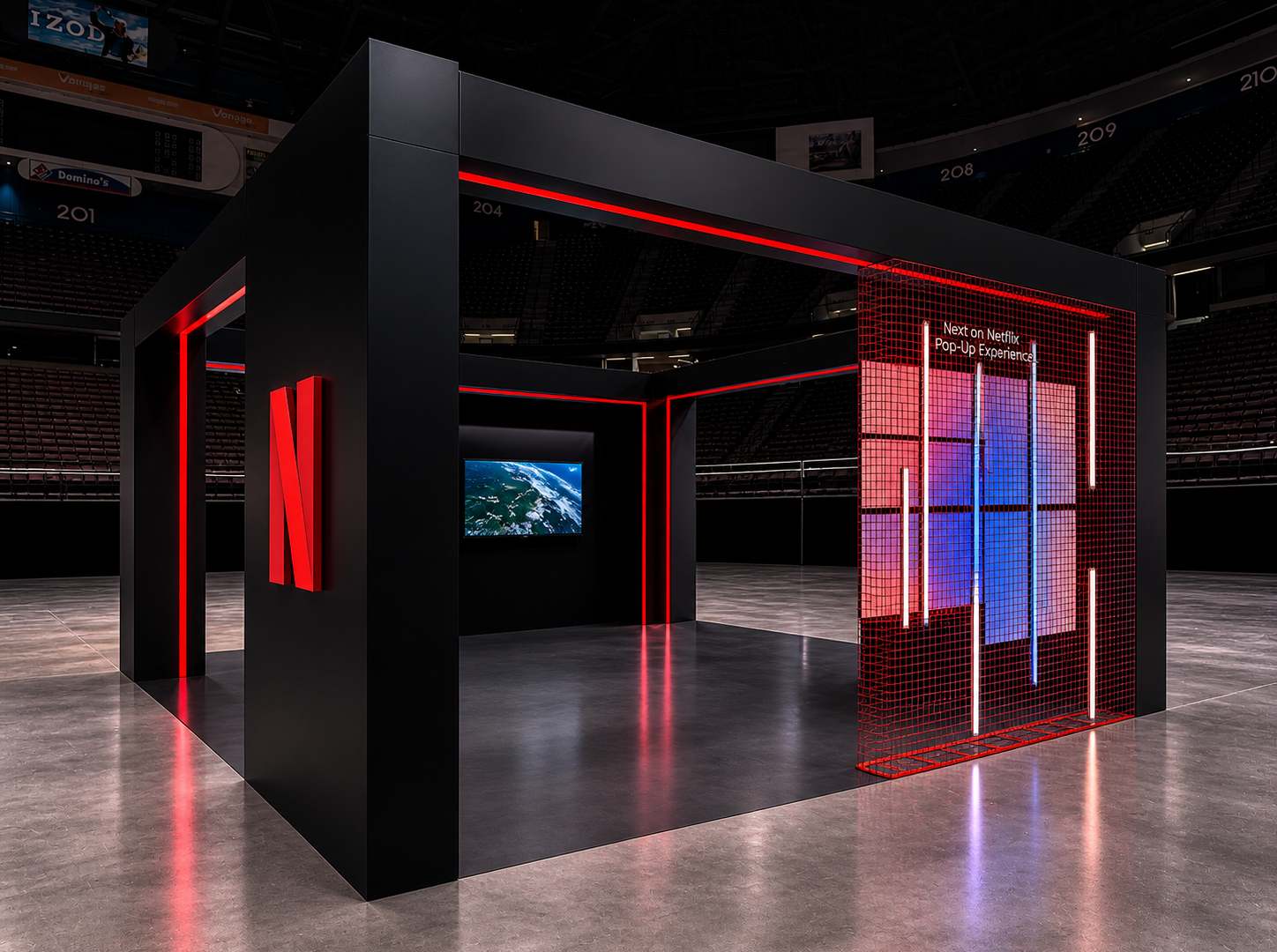
Netflix Trade Show Booth at the Meadowlands
The Brief & Challenge.
The CAD package landed in our shop with every dimension already locked. Netflix had approved the booth design internally; our job wasn’t to interpret or evolve it — it was to produce the exact build the drawings called for, fabricated to render-grade tolerances, in two weeks. Any deviation reads as a defect on a 22×22 trade show floor where the Netflix LED logo is the focal point and 2,000-plus people will photograph it.
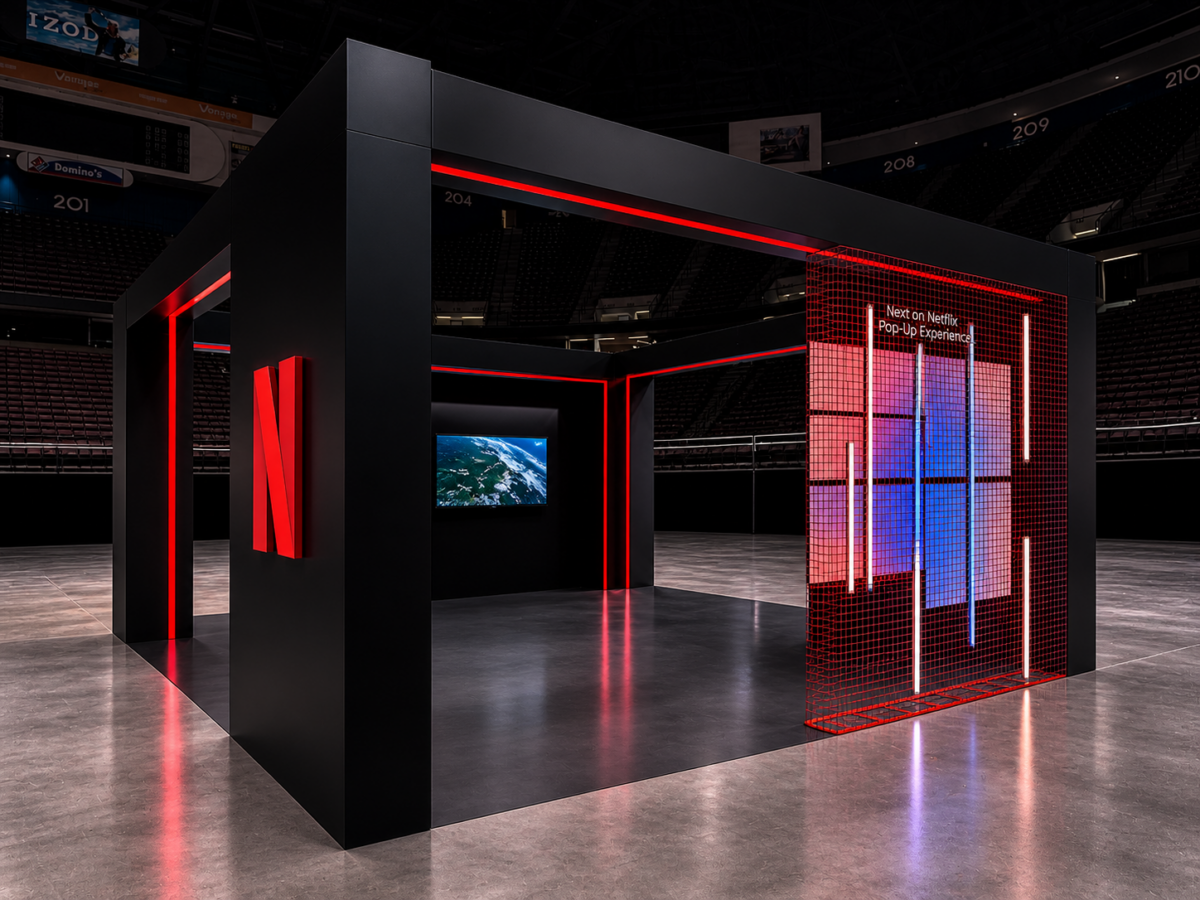
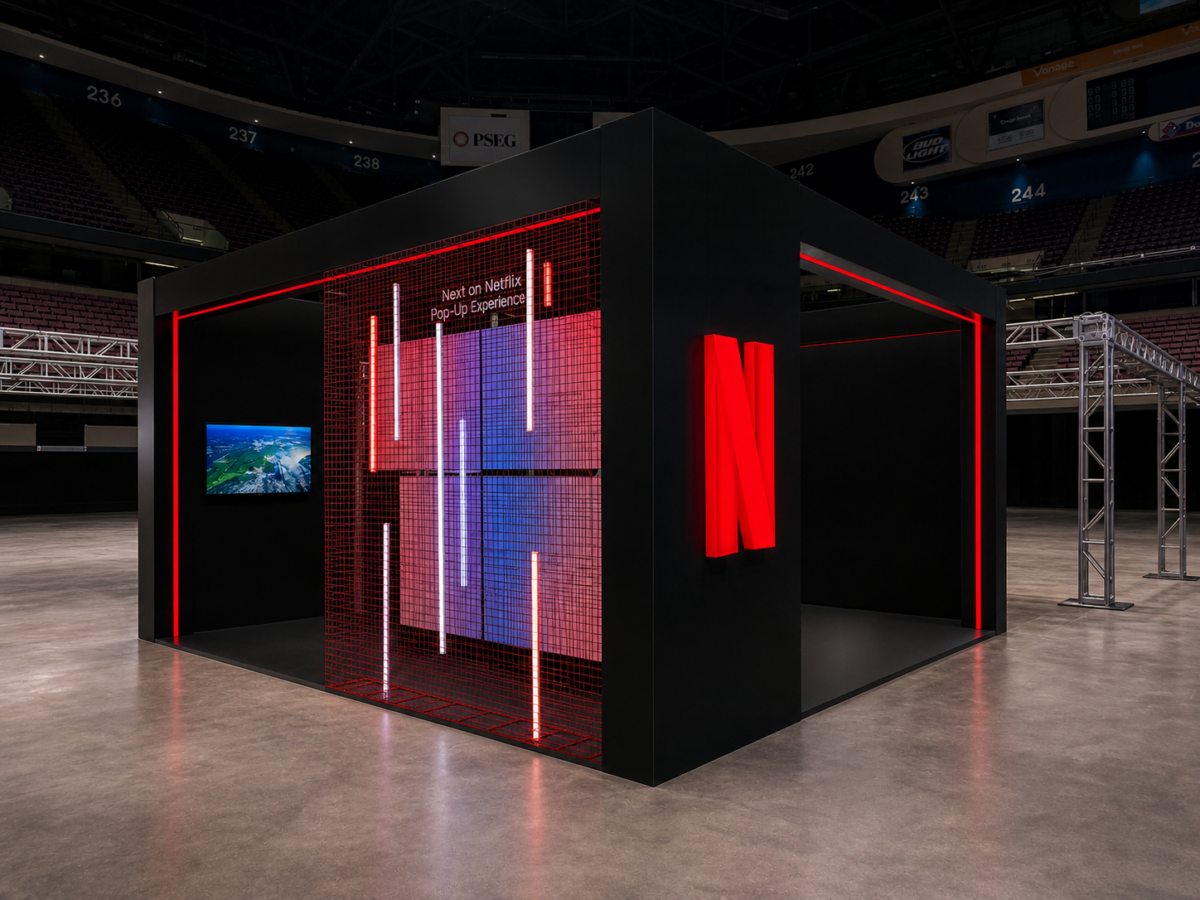
A footprint that tight forces every square foot to do work. Custom millwork walls had to host flush-mount televisions sitting at exact bezel depth — a sixteenth of an inch off and the screens look retrofitted. Each TV pocket needed internal cabling channels so nothing routed visibly behind the wall surface. The Netflix LED logo had to sit at brand-spec dimensions, color-calibrated to Netflix red under the convention center’s mixed lighting, and powered cleanly inside the booth’s electrical envelope. Custom display fixtures, lighting, and structural framing — all designed-in, none added as afterthoughts.
Two weeks doesn’t leave room for sequence. A trade show booth at this scope normally runs four to six weeks: drawings review, shop fabrication, finish, electrical and AV integration, dry fit. Compressing that to fourteen days means every fabrication trade — millwork, metal, finish, lighting, electrical, AV — runs in parallel from day one, with zero margin for a missed handoff. That’s only achievable if the design is fully locked at kickoff. Netflix’s was.
The Pop Solution.
Day one was engineering review. We pulled every drawing against shop reality — flush-mount TV depth, lighting fixture mounting, LED logo wiring routes — so the conflicts surfaced before the saw cut anything rather than during install. By day three, shop drawings matched Netflix’s approved package exactly, and every trade was running. Our trade show fabrication discipline kicked off in parallel with metalwork, electrical, finish, and AV.
Wall sections were built as modular panels in our NYC shop. Each panel was finished to Netflix’s specified material callouts and engineered with internal channels so the flush-mount TV cabling routed cleanly behind the surface. Bezel tolerance was set to drawings — every TV pocket sized to bury the screen exactly, not a sixteenth off. Custom display fixtures sat in matching finishes, integrated into the wall geometry rather than dropped in.
The Netflix LED logo carried the booth’s center of gravity. We fabricated it to Netflix’s brand-spec dimensions, color-matched the LED output under tested trade show lighting, and routed power through the booth’s primary electrical envelope so the logo carried no visible cabling. Custom lighting fixtures across the booth were built to the design package, with color temperature and beam pattern selected for consistent read across surfaces and on-camera. Every brand activation on a trade show floor lives on how it photographs — the booth had to perform on-screen as well as on-floor.
The two-week clock only worked because every trade ran simultaneously. Millwork, metal, finish, electrical, and AV — none of them waited on the others. We pre-built and dry-fit the booth in the shop ahead of load-in to confirm panel alignment, fixture seating, and TV pocket depth before anything moved to the Meadowlands. Onsite was an assembly operation, not a problem-solving one. The booth opened to its 2,000-plus attendees identical to the package Netflix had approved fourteen days earlier.
Core Fabrications

THE OUTCOME.
The booth opened on schedule. Every flush-mount TV, custom display fixture, and the Netflix LED logo read exactly as the approved CAD package specified — no visible defect, no missed milestone, no subcontractor in the chain. Two weeks from drawings to install, executed end-to-end out of our NYC shop.
The 2,000-plus trade show attendees experienced a booth identical to the renders Netflix had signed off internally. Netflix walked away with a fabrication partner that delivered to spec on a compressed timeline most shops won’t take.