Nov 13, 2026 · Pop-Ups & Retail
How Much Does a Pop-Up Shop Cost to Build?
A custom pop-up shop build runs $25,000 to $250,000 and up, depending on footprint. What the build price includes, what moves it, and what venue, staffing and permits add on top.
A pop-up shop has two budgets, and most first estimates blur them. One is the build: the walls, fixtures, counter, graphics and lighting that turn an empty storefront into a store. The other is everything around it: rent, staff, insurance, permits and product. A number that mixes the two is useless to compare, because a fabricator prices only the first and a landlord prices only the second.
This guide separates them. It gives the build ranges by footprint, shows what sits inside the build price, puts numbers on the lines that sit outside it, and explains what moves a project up or down inside its range. Every figure comes from our own published planning ranges, and the examples are projects we built in our New York shop.
How much does a pop-up shop cost to build?
A custom pop-up shop build costs $25,000 to $60,000 for a space under 500 sq ft, $60,000 to $120,000 for 500 to 1,500 sq ft, and $120,000 to $250,000 or more for a large or multi-market program. Those ranges cover design, fabrication, graphics and installation. Venue, staffing, permits and product are separate.
| Pop-up build | Footprint | Typical build range | What is usually in it |
|---|---|---|---|
| Small | Under 500 sq ft | $25,000 to $60,000 | Custom fixtures, merchandise display, a fitting area, a point-of-sale station, branded environment |
| Mid-size | 500 to 1,500 sq ft | $60,000 to $120,000 | Wall systems, a full fixture package, a hero photo moment, facade treatment, feature lighting |
| Large or multi-market | 1,500 sq ft and up, or 3 to 8 markets | $120,000 to $250,000+ | Zoned environments, touring engineering, road cases, repeat installs |
Projects in our shop start at $25,000 for design and buildout. That floor is the reason the small range begins where it does: below it, a brand is usually buying stock fixtures and printed vinyl, which is a different purchase from a custom build.
Multi-market programs carry one more line. Each city after the first needs its own delivery, install and strike, which typically runs $10,000 to $25,000 per market on top of the one-time build.
This guide covers temporary and touring pop-ups. A permanent store fit-out is a different trade with a different budget, and it is not work we take on.
What does the build price include?
A pop-up build price covers the work from first sketch to open doors: design, drawings, fabrication, graphics, lighting, delivery and installation. If a quote leaves one of those out, it should say so in writing.
Here is what a complete build scope lists:
- Design and renderings. A floor plan drawn to the real space, then renderings the brand team can approve. Our 3D event visualization work exists so that the approval happens on a screen, not on install day.
- Shop drawings. Dimensions, materials, joinery and power for every element. The landlord and the electrician work from these.
- Walls and facade. Freestanding wall systems, a storefront treatment and any dimensional signage.
- Fixtures. Display tables, plinths, wall-mounted shelving, garment racks, vitrines and a cash wrap.
- Graphics. Printed wall panels, window vinyl, wayfinding and price signage. In-house large format printing keeps color matched across substrates.
- Lighting. Integrated LED in fixtures and signage, plus accent lighting where the space's own fixtures fall short.
- Pre-assembly. The whole shop is stood up in our shop before it ships, so fit problems are found on our floor.
- Delivery, installation and strike. Crew, truck and tools, on the landlord's schedule.
What the build price does not include is just as important. Rent, staffing, inventory, insurance, permits, landlord fees, utilities and point-of-sale hardware belong to the program budget, covered in the next section.
What does the whole program cost beyond the build?
Fabrication is usually the largest single line in a pop-up budget, about 40 to 55 percent of the total program in our planning budgets. Venue, staffing and operations make up most of the rest, and they scale with how long the doors are open rather than with what is built.
Planning figures for the lines outside the build:
| Line | Small, single market | Mid-size, single market |
|---|---|---|
| Venue | $5,000 to $15,000 | $10,000 to $30,000 |
| Staffing and operations | $10,000 to $20,000 | $20,000 to $50,000 |
Venue cost depends on the kind of space more than its size. Premium storefront rent in a top retail corridor runs $15,000 to $50,000 or more per month. Gallery and event spaces, which often rent by the week, run $5,000 to $20,000 per week. A two-week pop-up in a gallery and a two-month pop-up in a storefront can land on similar venue totals for very different reasons.
Insurance is a requirement, not an option. Landlords typically ask for a certificate of insurance with $1 million to $2 million in liability coverage before anyone loads in.
A quick way to sanity-check a total: take the build number and divide by the fabrication share. A $40,000 build at 40 to 55 percent of the program implies a total between roughly $73,000 and $100,000. If the rest of the budget is far below that, either the venue is unusually cheap or a line is missing.
What moves a pop-up build up or down inside its range?
Five things decide where a build lands inside its range: the condition of the space, the fixture count and finish level, lighting and technology, the facade, and the install window. Square footage sets the range; these set the position inside it.
The condition of the space. A finished retail unit with good lighting and working power needs less built into it than a raw shell. The Celsius pop-up in SoHo is the raw case: an 1,800 sq ft white-box storefront with limited electrical capacity and tight load-in access. Lighting, power distribution and every finished surface had to arrive with the build.
Fixture count and finish. Fixtures are the most countable part of a pop-up, which makes them the easiest line to adjust. Typical price points for custom pieces:
| Fixture | Typical range |
|---|---|
| Nesting display table set | $3,500 to $8,000 |
| Plinth with integrated LED | $900 to $2,800 |
| Wall display system, per 8 linear ft | $3,000 to $7,500 |
| Garment rack | $1,200 to $3,500 |
| Cash wrap | $5,000 to $15,000 |
| Vitrine | $1,500 to $4,000 |
A complete custom fixture package for a 400 to 800 sq ft shop runs $25,000 to $75,000. Our guide to pop-up shop fixtures covers materials and construction for each piece.
Lighting and technology. Integrated LED, screens and interactive elements add both hardware and power planning. A space with limited electrical capacity may also need distribution brought in.
The facade. A storefront treatment is what the street sees. Window vinyl is the low end. A dimensional facade with lighting is a build in itself.
The install window. A three-day install uses a normal crew on normal hours. A one-night install needs a larger crew, more pre-assembly and a tighter sequence, and the engineering for that speed is paid for in the shop.
Square footage sets the range. The space, the fixtures and the install window decide where in the range you land.
What does a mall or landlord-controlled space add?
A mall or other landlord-controlled space adds documentation, overnight labor and reinstatement to the budget. The build itself may cost the same as in a street storefront; the conditions around it do not.
Typical added lines in a mall program:
- Design and documentation: 8 to 15 percent of fabrication, for the drawing package the landlord's design review asks for.
- Overnight install labor: $12,000 to $40,000, because most malls allow construction only outside trading hours.
- Freight and crating: $5,000 to $20,000, driven by dock rules and delivery windows.
- Strike and reinstatement: $6,000 to $18,000, to return the unit to the condition in the lease.
- Landlord fees and deposits: $3,000 to $15,000.
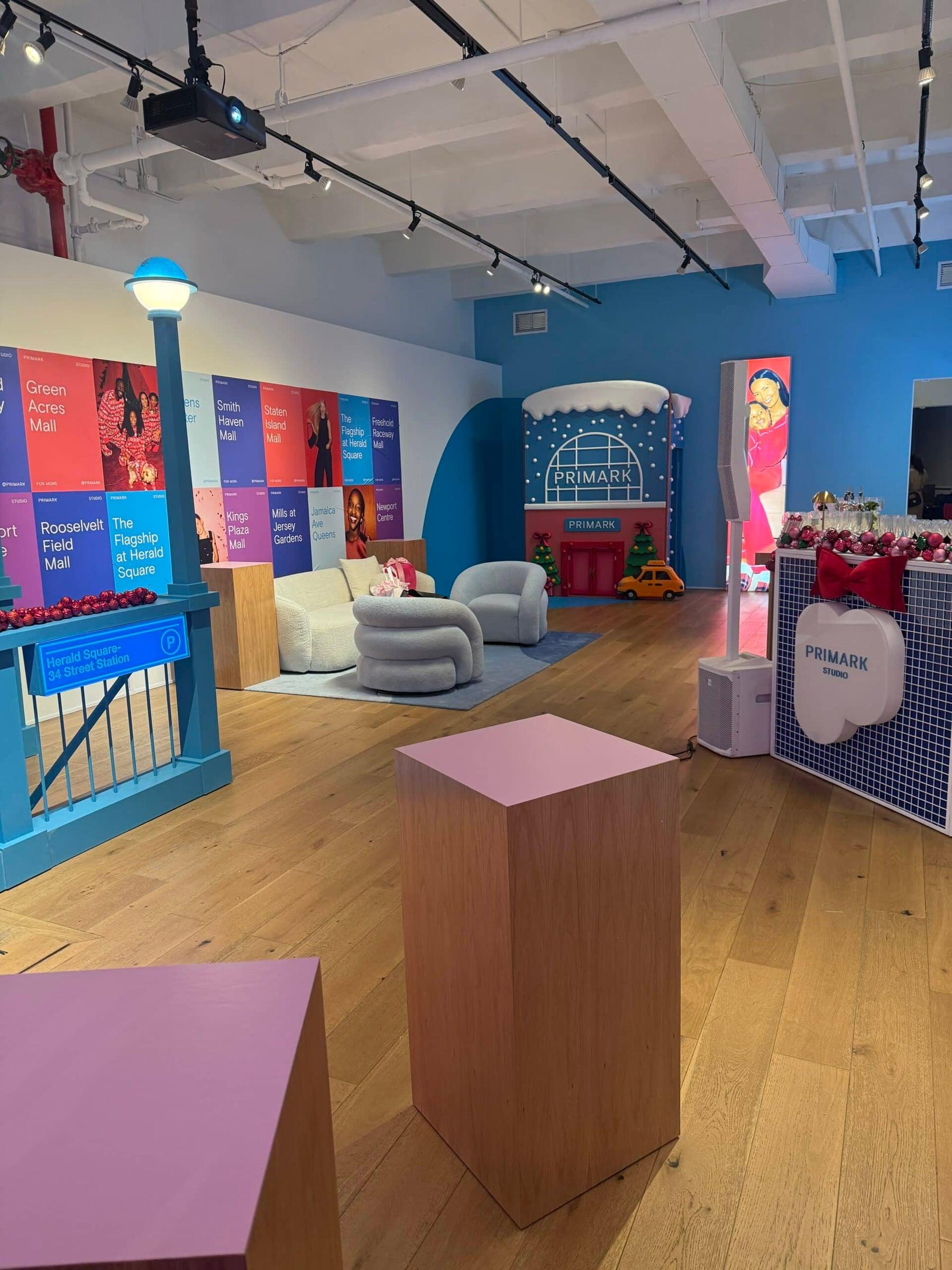
Overnight work is a design requirement as much as a labor cost. The Primark holiday pop-up near Herald Square was 2,400 sq ft of custom fixtures, a gift wall, a gift-wrapping station and a photo moment, and the whole shop installed in one night. That only works when fixtures are built to retail standards and engineered for fast assembly at the same time.
Our mall pop-up fabrication guide walks through the landlord's approval process and the drawing package in detail.
Does a touring or multi-city pop-up cost more?
Yes, at the build stage. Engineering a pop-up to travel typically adds 20 to 30 percent over a stationary build of the same size. The money goes into road cases, modular connections, repeatable assembly and finishes that survive a truck.
The premium is spread over every stop. A $40,000 touring kit used in ten cities works out to $4,000 of build cost per activation, before per-city delivery and install. A stationary build of the same size is cheaper once and worth nothing at the second location.
What a touring build changes:
- Connections. Panels join with hardware a small crew can assemble without specialist tools, in the same sequence at every stop.
- Cases. Every element has a labeled place in a case or crate sized for a truck and a freight elevator.
- Graphics. City-specific panels are designed to swap. A graphic refresh typically runs $2,000 to $5,000 per set.
- Footprints. The kit is drawn to fit more than one floor plan, since no two venues match.
Our mobile pop-up fabrication page covers how touring kits are engineered. A trailer-based build is a different budget again, because the vehicle is part of the structure.
How does the timeline change the price?
A straightforward pop-up takes three to four weeks from approved design, and a fully custom one takes six to ten weeks. Shop fabrication accounts for 15 to 30 business days of that. Projects that start inside those windows can still be built, but the options narrow and the trades run in parallel instead of in sequence.
Time costs money in three ways:
- Material choices shrink. Long-lead finishes and custom-ordered hardware drop off the list, and in-stock substitutes take their place.
- Trades overlap. Carpentry, metal, paint, print and lighting work at the same time, which leaves no slack for a late approval.
- Install gets tighter. A short venue window means more pre-assembly in the shop and a larger crew on site.
The Keurig launch at the Nasdaq MarketSite shows the compressed end done properly. The Keurig build in Times Square ran five weeks from brief to live event with a 12-hour install window. Every component was engineered for rapid assembly with pre-wired electrical and labeled connections, and a crew of eight installed 3,200 sq ft overnight.
The cheapest schedule is the one where approvals arrive on time. Our six-week pop-up build-out timeline lays out which decision is due in which week.
How do you keep a pop-up build on budget?
Keep a pop-up on budget by fixing the brief before design starts, spending on what customers touch, and deciding early what gets reused. Most overruns come from changes after drawings are approved, not from the original scope.
Practical moves, in the order they matter:
- State the budget range in the brief. A designer who knows the number draws to it. One who does not draws something that has to be cut later.
- Spend at arm's length. Put the finish budget into the cash wrap, the hero fixture and the photo moment. Back walls and high surfaces can be simpler.
- Use the space. If the venue's floor, ceiling and lighting are good, leave them alone.
- Repeat fixtures. Four identical display tables cost less than four unique ones, because the shop sets up once.
- Plan the second use. Fixtures that move to a retail partner or a second city change the math on the first build.
- Lock drawings, then stop. A change order after fabrication starts costs more than the same change made on paper.
For smaller footprints inside another retailer's store, our retail activation builds page covers shop-in-shops and freestanding displays. Our value engineering guide shows how to take cost out of a design without the result looking cut.
Get a line-item pop-up quote
A useful pop-up quote lists each line on its own: design, drawings, walls, fixtures, graphics, lighting, delivery, installation and strike. That is how you see what a change adds or saves before you approve it.
To price a build accurately, send us:
- The address or the type of space, with a floor plan if you have one
- Open and close dates, and the landlord's install window
- What the shop has to do: sell, sample, launch, host events
- A fixture list or a product count
- Brand guidelines and any reference images
- A budget range
- Whether the build has to travel or be reused
We return a line-item quote within 2 business days. Projects in our shop start at $25,000, and every build is pre-assembled in our Midtown Manhattan shop before it goes to site. Permits and landlord approvals are filed by the client or agency, and we supply the drawings, site plan and material certificates those filings need.
Start with our pop-up shop design and fabrication page, or send the brief and we will tell you where in the range your project sits.
Frequently Asked Questions
Frequently Asked Questions
A custom pop-up shop build runs $25,000 to $60,000 for a space under 500 sq ft, $60,000 to $120,000 for 500 to 1,500 sq ft, and $120,000 to $250,000 or more for a large or multi-market build. Those figures cover design, fabrication, graphics and installation. Venue, staffing and permits are separate. Projects in our shop start at $25,000.
Design and renderings, shop drawings, custom fixtures and wall systems, a point-of-sale counter, printed graphics, lighting, shop pre-assembly, delivery and installation. Rent, staff, inventory, insurance, permits and landlord fees are not part of the build price.
Fabrication is usually the largest single line, about 40 to 55 percent of the total program in our planning budgets. Venue, staffing and operations make up most of the rest, and they scale with how long the shop is open rather than with what is built.
Yes, at the build stage. Engineering a pop-up to travel typically adds 20 to 30 percent over a stationary build of the same size, for road cases, modular connections and repeatable assembly. The premium is spread across every stop, so the cost per market falls with each city added.
A straightforward pop-up takes three to four weeks from approved design and a fully custom one takes six to ten weeks. Shop fabrication is 15 to 30 business days of that. The rest is design, approvals and the landlord's paperwork.
Have a build on the calendar?
Send the brief, renders or a napkin sketch. You get a line-item quote within 2 business days.