Oct 08, 2026 · Event Fabrication & Materials
Custom Prop Fabrication for Events: Foam, CNC and Finish
How oversized props and sculptural hero pieces actually get built: choosing between carved foam, CNC-cut sheet goods and welded armatures, re-proportioning at scale, finishing for the camera, and mounting a piece that has to travel.
Custom prop fabrication is the work of building a single object that does not exist yet — an oversized product replica, a sculptural hero piece, a dressing element that makes a room read as somewhere else. It has to look right on camera, survive a crowd, and fit through the door it must pass through. The method follows the object: carved foam, CNC-cut sheet goods, a welded armature, or all three.
Most briefs that reach our shop describe the prop by what it looks like. The drawings that come out of the shop describe it by how it holds together. That translation is the entire discipline, and it is where a prop either earns its place in every photograph or spends the event with a crew member standing behind it holding it up.
What a prop has to survive before anyone photographs it
A prop's hardest hours are not the ones on display. They are the hours in between: strapped in a crate, carried up a loading ramp, turned on its side to clear a freight elevator, set down on concrete by two people who cannot see each other past it. Custom prop fabrication that designs only for the display condition produces a piece that arrives already damaged.
So we work backwards from handling. Where will hands go, and is there anything there that can take the load? Which face lands on the ground when the piece is set down? What happens at the thinnest point in the geometry when the whole object is lifted from one end? A six-foot foam replica with a narrow waist will break at the waist, every time, unless there is something inside it that does not care about foam.
Public interaction is the second survival test. People touch props. They lean on them, put a drink on them, sit children on them, and push to see whether they move. Anything within arm's reach of a guest is a structural element whether the design calls it one or not, which is why we spec the contact surfaces of a prop differently from the surfaces nobody can reach.
Choosing the build method
There are four honest approaches to custom prop fabrication, and the choice is usually settled by three facts: the shape, the span it has to hold up, and whether anyone will get close enough to see a seam.
| Approach | Best at | The trade-off |
|---|---|---|
| Carved and coated foam | Organic, sculptural and compound-curved shapes; oversized objects where weight matters more than strength | No structural capacity of its own; the coating and the internal armature do the work |
| CNC-cut sheet goods and millwork | Faceted forms, repeatable parts, anything with flat planes, shelves or a cavity to hide hardware | Curves have to be approximated in layers or skinned, which adds steps |
| Welded steel or aluminum armature | Spans, cantilevers, floor loading, anything tall or leaned on | Heavier freight and a weld-out sequence that has to happen before any finish work starts |
| Hybrid shell over structure | Hero props: the look comes from the skin, the safety comes from the frame | Two trades have to agree on tolerances before either one cuts |
In practice the hybrid wins most of the time. Our shop keeps CNC cutting, metal fabrication and welding and scenic carpentry under one roof precisely because a hero prop is rarely one trade's problem. Foam-specific questions — density, hot-wire versus milling, coating systems, fire code — are worth reading on their own, and our guide to foam fabrication and EPS carving for events goes through them in detail. The material comparison across wood, metal, acrylic and composites lives in our event fabrication materials guide.
Scale: oversized objects have to be re-proportioned, not enlarged
The most common failure in custom prop fabrication is a faithful scale-up. Take a product and multiply every dimension by ten and the result looks wrong in a way clients struggle to name. The reason is that small objects carry details sized for the hand: a radius you read as sharp, a wall thickness you never notice, a label weight tuned for eight inches away.
Enlarged ten times, that sharp radius becomes a visible fillet, the wall thickness becomes a slab, and the label weight turns thin and apologetic across six feet of surface. We redraw the details at the finished size instead — tightening radii, thinning what should read as thin, thickening type so it holds at the distance people will actually stand. The prop ends up geometrically unfaithful and visually correct, which is the only fidelity that matters.
Scale also changes the sightline question. A tall prop is seen from below, so its top face disappears and its underside becomes a finished surface. A low prop on the ground is seen from above, so the joint you hid at the base is suddenly the first thing in frame. Deciding the viewing height early is what keeps finish work from landing on surfaces nobody will ever see.
The armature you never see
Every prop that matters has something inside it. For the "One Love" Pride installation we designed and fabricated for One World Observatory, the piece reads as stacked layers of clear laser-cut acrylic with a rainbow One World Trade Center at the center, and all of it hangs on an internal steel armature engineered for the observation deck's floor loading and for thirty days of hands-on public interaction. The layers are the design. The armature is the reason the design was allowed on the one-hundred-and-second floor.
Ground conditions drive the armature as much as the shape does. The nine oversized mirror-finish WHITE CLAW letters we fabricated, produced and installed for White Claw Sessions at The Surf Lodge sat on a low plinth base directly on the sand — each letter built as an individual unit, engineered for sand, salt air and the wind coming off Fort Pond. Sand does not accept an anchor the way a deck does, so the structure has to solve stability by footprint and ballast rather than by fastening. Rooftops, raised floors and historic venues each impose their own version of that constraint, and the engineering review is where it gets resolved — not the install day.
The honest rule: if a prop is tall, leaned on, climbed on, or outdoors, its internal structure is engineered before its surface is designed. Reversing that order produces beautiful drawings and a piece that cannot be approved.
Finish is most of the job
A prop is a finish wearing a structure. Substrate choice, primer, fill, sand, and the paint system on top decide whether the object reads as a real thing or as a shop-built approximation — and that judgment happens at a specific distance. Phone-camera distance is the standard worth building to, because that is where the piece will be judged by everyone who was not in the room.
For Magic Hour Mountain Lodge on the eighteenth-floor rooftop at Moxy NYC, we fabricated faux log cabin walls finished to read as timber from exactly that distance, with a Western decor gallery wall — bighorn antlers, cowboy boots, rope detailing — and faux snow treatments to complete the environment. Nobody mistook it for a cabin at arm's length. In every photograph taken on that rooftop, it was a cabin.
| Viewing distance | What the finish must hold |
|---|---|
| Arm's reach (touchable props, bar tops, fixtures) | True seam and edge quality, durable topcoat, no telegraphing of substrate joints |
| Phone-camera distance (photo moments, hero props) | Correct sheen and texture under the room's actual lighting; color accuracy to the brand standard |
| Across a room (backdrops, large dressing elements) | Silhouette, value contrast and scale of texture; fine detail is wasted here |
Reflective finishes deserve their own warning. A mirror-polished surface does not have a color — it has whatever is in front of it. Specify mirror finish and you are also specifying the ceiling, the crowd and the sky as part of the piece. That is a gift outdoors on sand and a liability under a grid of exposed lighting, and it is a conversation our scenic painting team wants to have before the first sample is sprayed, not after.
Mounting, crating and the second life
Props are built in sections because of doors, elevators and trucks, and the question is never whether to break the piece up but where the breaks go. We put them where the geometry already changes direction — a shoulder, a fold, a shadow line — so the joint hides in a feature instead of interrupting a flat surface. The acrylic cityscape travelled to One World Observatory in modular transport and install sections for exactly this reason, and it struck cleanly at the end of the run with no damage to the venue.
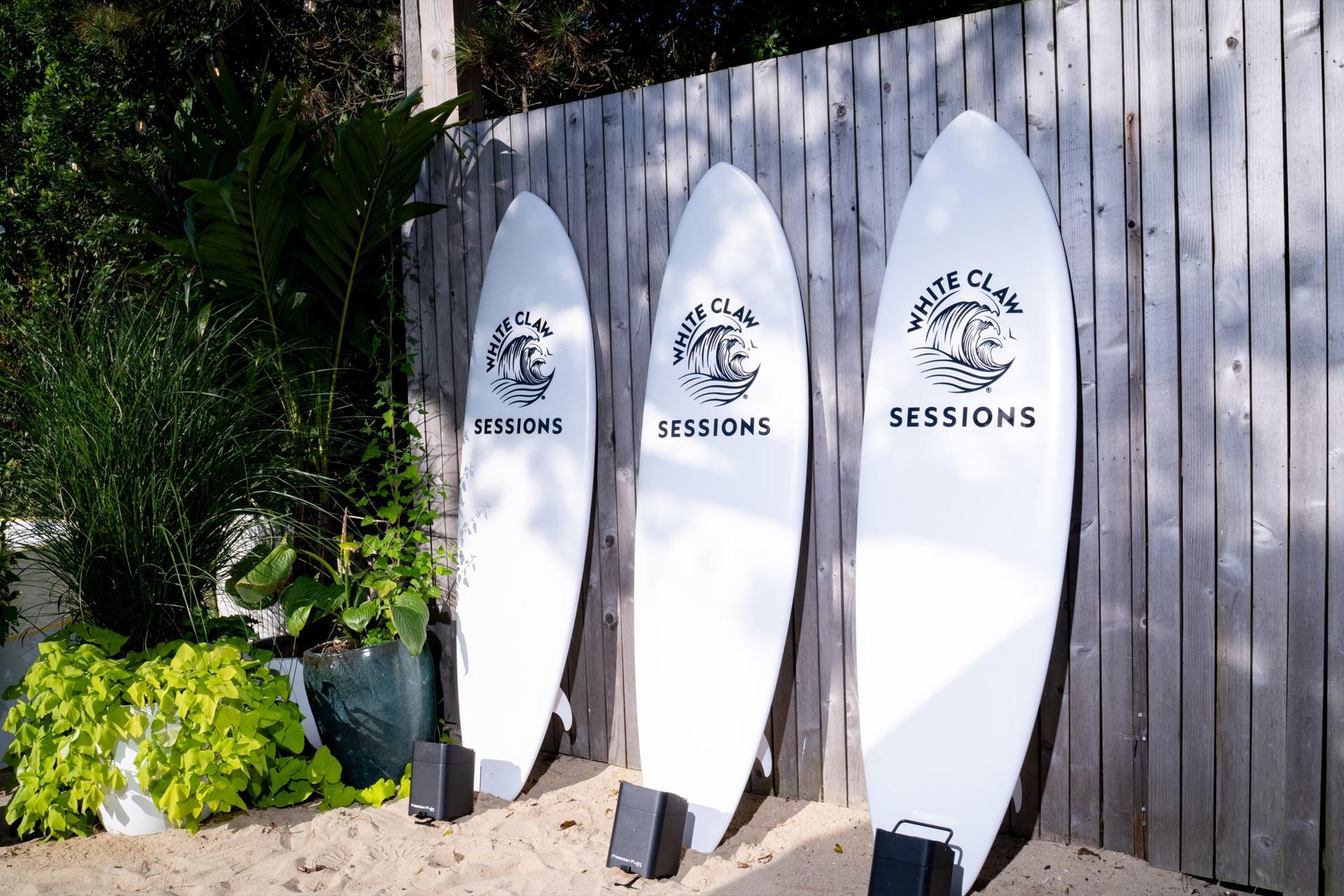
Mounting hardware deserves the same forethought. Freestanding mounts kept the custom White Claw Sessions surfboards upright at the entrance and around the property without touching the building. Non-permanent hardware is what let the Moxy rooftop build rig around existing dining tables without a fastener in a structural wall or a guard rail. "Do not touch the venue" is a common brief, and it is a fabrication constraint, not an install improvisation.
Finally, decide the afterlife before the strike. A prop built to be redeployed needs its own crate, labelled sections, a reassembly sequence and hardware that survives being removed and reinstalled. A prop built for one night can be lighter, simpler and faster. Both are legitimate; what wastes a build is choosing the second and then being asked for the first three months later.
What a shop needs from the brief
Good custom prop fabrication starts with a brief that answers the physical questions. The object's finished dimensions and the one dimension that is non-negotiable. The venue, the floor it stands on, and the narrowest opening between the truck and the final position. Whether guests can touch it. The nearest power, if it lights up. The viewing distance and the hero camera angle. Whether it ships again after this.
When those facts are missing, a shop assumes — and the assumptions are always conservative, which means heavier structure, more finish and longer lead time than the job may have needed. Sending site facts early is the cheapest way to make a prop lighter and faster. Our team at Pop Up Your Brand works on that principle: the brief that reads like a build turns into a build that reads like the render.
If you have a hero object in a deck and no idea yet how it stands up, that is the right moment to talk to a shop rather than the wrong one. Send us the render, the venue and the date, and we will tell you what it wants to be made of — our event fabrication team is in Midtown Manhattan, and we are glad to start from a sketch. Start a conversation with our shop and we will work the structure out with you.
Frequently Asked Questions
Frequently Asked Questions
Most props are built from one of four approaches or a hybrid of them: carved and coated foam for organic and compound-curved shapes, CNC-cut sheet goods and millwork for faceted forms and repeatable parts, welded steel or aluminum for spans and floor loading, and a shell over a structural frame for hero pieces. The shape, the span and the viewing distance decide which one.
It depends on the structure more than the surface. A clad-and-painted prop built from sheet goods moves quickly; anything with a welded armature, a carved form or a custom finish sample adds a weld-out and a cure sequence that cannot be compressed. Engineering review comes first, so sending venue facts and final dimensions early is what shortens the schedule.
Yes, if it is built for it from the start. A redeployable prop needs labelled modular sections, its own crate, a documented reassembly sequence, and hardware rated for repeated removal. Props built for a single night are deliberately lighter and simpler. Deciding which one you need before fabrication starts is what prevents a rebuild later.
By solving stability in the fabrication, not on install day. That means freestanding mounts, ballasted plinth bases, footprints wide enough to resist a push, and non-permanent hardware that rigs to existing furniture or structure. Outdoor and rooftop locations add wind to the calculation, which is settled in engineering review before any part is cut.
Finished dimensions and which one is non-negotiable, the venue and the floor the prop stands on, the narrowest opening between the truck and the final position, whether guests can touch it, nearby power if it lights up, the hero camera angle and viewing distance, and whether it ships again after this event.