Oct 29, 2026 · Trade Shows & Exhibits
Trade Show Hanging Signs: How Custom Signs Get Built
How a custom trade show hanging sign is designed, framed, skinned, lit, weighed, approved and hung: frame choices, weight per hang point, rigging plans and the show deadlines that come with them.
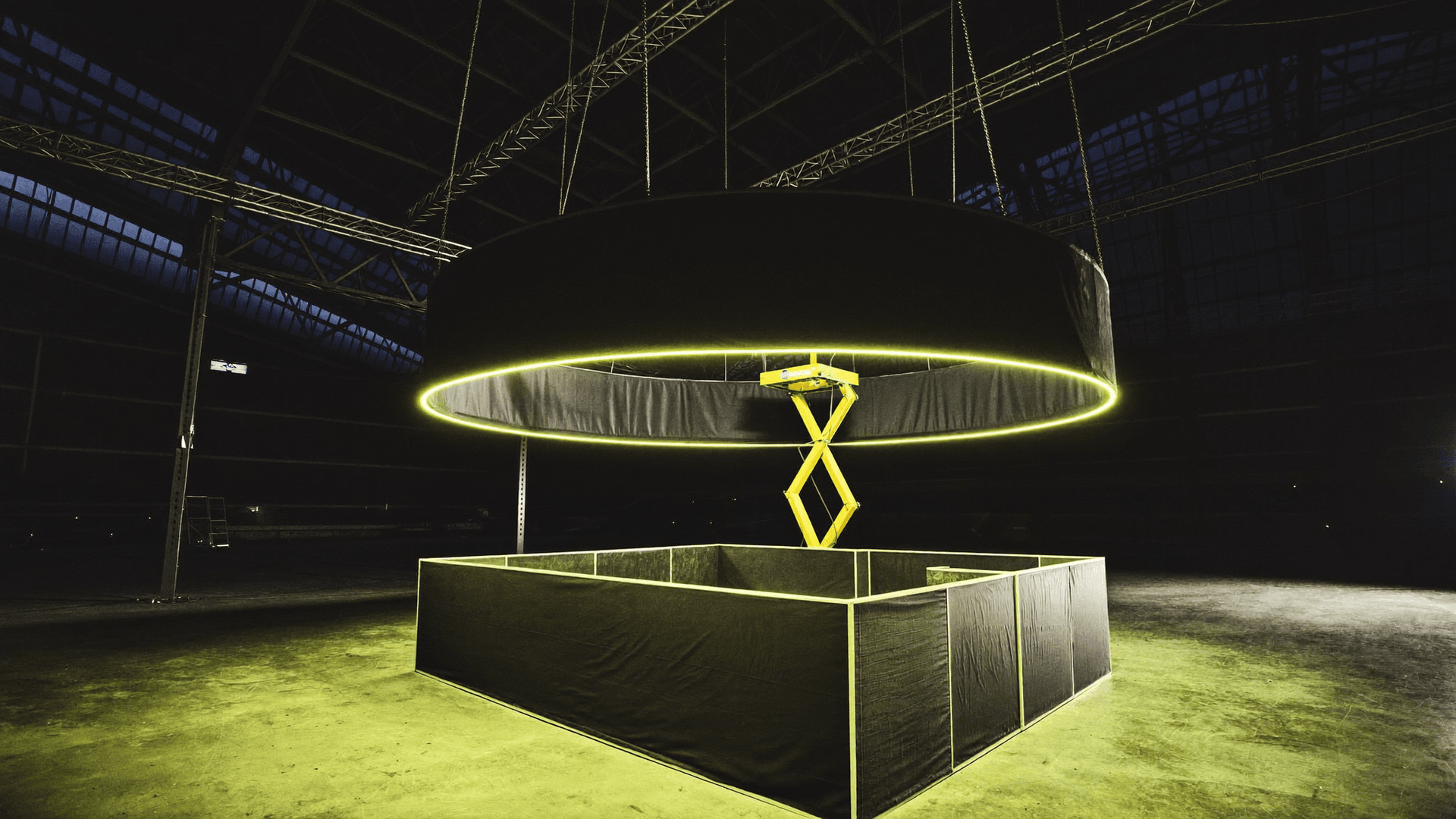
On a show floor, the hanging sign is the first part of your booth anyone sees. Attendees spot it from the hall entrance, over everyone else's back walls, long before they can read a counter graphic. Trade show hanging signs are also the one part of the booth that hangs from someone else's ceiling. So a rigging contractor, a weight limit, a drawing deadline and sometimes a structural engineer's stamp stand between the render and the sign in the air.
This guide covers how a custom hanging sign is designed, framed, skinned, lit, weighed, approved, shipped and hung. It's written from the shop side, where these signs get welded, stretched and crated.
What is a trade show hanging sign, and which booths can have one?
A trade show hanging sign is a fabricated sign suspended from the hall ceiling above an island or peninsula booth. It marks the booth from across the hall and is rigged by the show's official rigging contractor where the venue assigns that work to it; where the rules allow, our own crew hangs it.
Under the IAEE Guidelines for Display Rules and Regulations, hanging signs are allowed over island and peninsula booths, and each show sets the maximum height, measured to the top of the sign. Inline booths generally can't hang anything. We cover the full booth-type rules in the island and peninsula rules in our 20x20 guide, so this post stays on the build.
A good sign does three jobs:
- Find. It's visible over the walls from the main aisles and the hall entrances.
- Frame. It claims the airspace over your footprint, so the booth reads as one space from every side.
- Match. It carries the booth's shapes, colors and materials overhead instead of looking like an add-on.
That last job is why we design the sign with the booth, not after it. When the sign is part of the custom exhibit design from the first render, its hang points, weight and graphics land on the same drawing set as the walls below it.
Should you pick a stock shape or a custom form?
Stock shapes (ring, square, triangle) are the fastest to engineer and read cleanly from a distance. Custom hanging signs (a logo shape, a product form, a canopy) cost more to engineer and pattern, but they are the only way to put something overhead that no other booth has.
| Form | How it reads from the aisle | How it's built | What drives its weight | Best fit |
|---|---|---|---|---|
| Ring or circle | Same from every direction | Bent aluminum tube or rolled steel | Diameter and fabric height | Islands with traffic on all sides |
| Square or rectangle | Four flat faces, simple artwork | Straight tube frame | Overall size | Most islands and peninsulas |
| Triangle | Three faces, often turned to the main aisles | Straight tube frame | Overall size | Peninsulas and corner-heavy floors |
| Tapered, wave or curved | Movement and a softer outline | Bent tube or CNC-cut ribs | Rib count and fabric patterning | Brands that want a less boxy form |
| Custom 3D form (logo, product, canopy) | Unique on the floor | CNC-cut ribs, welded frame, or carved foam over structure | Material choice and cladding | Signature booths |
| Multi-tier or stacked | More height and presence | Several frames joined | Total weight and number of hang points | Large islands |
A custom form starts as a drawing, not a catalog number. The outline, the panel breaks, the joint locations and every hang point are set in the fabrication drawings before anything is cut. If the form carries raised letters or a logo face, the same rules as our dimensional logo work apply, with one difference: every ounce of it now hangs from a point someone has to approve.
What holds the sign up: aluminum and fabric or welded steel?
Most hanging signs are an aluminum tube frame with a tension fabric skin, because it's light and packs small. Welded steel takes over when the form is large, cantilevered or carries rigid panels and letters, and the extra weight has to be checked against the show's limits early.
| Frame | Typical use | Weight | Strengths | Watch-outs |
|---|---|---|---|---|
| Aluminum tube with tension fabric | Stock shapes and many custom outlines | Lightest | Fast to assemble, small crate | Limited for heavy or cantilevered forms |
| Welded steel frame | Canopies, large custom forms, signs carrying rigid panels or letters | Heaviest | Rigid, holds complex geometry | Weight per hang point; visible welds must be finished |
| Truss-based structure | Long spans, signs that carry lighting | Medium to heavy | Published load tables | Reads as industrial unless clad |
Our metal shop runs MIG and TIG welding, tube bending and a plasma table, and its regular output includes canopy frames, signage armatures and LED mounting frames. We TIG-weld exposed aluminum joints for a clean bead and MIG-weld concealed structural steel for speed and penetration. For reuse, welded steel sign frames are broken into sections with bolt-together connections and alignment pins, so they come apart for the crate and go back together square.
The clearest example from our own work is Thermacell's welded steel canopy sign at IBS. The 20x30 island at the Las Vegas Convention Center had to meet the show's hanging sign weight limits and fire code requirements. We built a custom welded steel canopy structure for the sign, pre-assembled the full booth in our NYC shop, crated it and installed it in the allocated 8-hour window with local union labor.
"The hanging sign was visible from across the hall, establishing brand presence before attendees reached the booth."
Pop Up Your Brand, Thermacell at IBS case study
What goes on the frame, and how does it read from every side?
The skin is usually dye-sublimated tension fabric, printed and sewn to fit the frame. Rigid panels and dimensional letters are the alternative when the sign needs depth, at the cost of weight.
Fabric skins
A trade show hanging banner is, in most cases, a hanging fabric sign: a printed fabric sleeve pulled over a frame (pillowcase style) or a fabric face with a silicone edge pressed into a channel. A tension fabric hanging sign of either kind weighs little and folds or rolls into a small case. Our dye-sublimated fabric printing treats fabric as the durable reusable option: it's machine-washable, rolls for transport and re-tensions in its frame many times. For channel-mounted faces, the same edge detail as our guide to silicone edge graphics applies, just turned on its side and hung.
Inside faces and double-sided prints
On a ring or a square, the inside faces are seen from inside your booth. Decide what goes there: a second message, a pattern, or a plain color that keeps the eye on the product below. Double-sided and backlit translucent prints are both standard for us; the choice changes the fabric and, for backlit faces, the weight.
Artwork and fire paperwork
- Logos and type as vector files (Illustrator, EPS or PDF).
- Photos at 150 to 300 DPI at final printed size.
- Pantone references for every brand-critical color.
- Our print templates carry bleed, trim and safe areas for the exact frame, so seams don't cut through a letter.
Fabric and other materials must meet the flame-retardant requirements in your show's manual and the venue's rules. Check the manual for the standard it names, and keep the certificate with the sign in the crate.
Can a hanging sign light up, and what does that add?
Yes. A sign can be lit from inside, with LED behind backlit fabric, or carry applied light, such as edge-lit letters or a lit logo. Either way, power arrives as a drop from the ceiling, the show's electricians usually make that connection, and the drivers go where a lift can reach them. Lights, drivers and cable all add to the weight you report for each hang point, which the next section covers.
Color is the other half of a lit sign. A logo that's correct on screen can drift under a hall's mixed lighting. On our Netflix booth, we built the LED logo to brand-spec dimensions, color-matched its output to brand red under tested trade show lighting, and routed power through the booth's main electrical so no cable showed. That was a wall logo, not a hanging sign, but the method is the same overhead: LED integration for lit signs is specified, built and tested in the shop, the way we did with the Netflix logo color-matched to brand red.
How heavy can the sign be, and when does it need an engineer's stamp?
There is no single weight limit for trade show hanging signs. What every rigging contractor asks for is the total weight and the weight on each hang point, and the thresholds that trigger extra approval, motors or stamped drawings are set show by show. Here is what three sets of published rules say.
- Las Vegas Convention Center, Freeman rules as published for SEMA: any object over 200 lbs, or any object that needs chain motors, goes to Freeman for LVCC approval. The LVCC rigging regulations add that special or unusual weights need written permission from the venue's Director of Engineering.
- NAB Show 2025 work rules (LVCC): a chain hoist is required for anything over 200 lbs. The document marks this as new; older kits for the same building say 250 lbs, so read the current year's manual.
- GES hanging sign information pages (2024 shows): every sign except cloth and vinyl banners needs structurally engineered rigging points and blueprints carrying a current structural engineer's stamp.
For the build, that means three things. Weigh the finished sign in the shop with everything attached: frame, skin, lights, drivers, cable and rigging hardware. Put the weight per point on the drawing, not just the total. And use rated hardware throughout, because the weakest component sets the capacity of the point. Our rigging and structural engineering guide covers working load limits and safety factors in full, and the guide to lighting a hanging sign covers the power side.
What drawings are due, to whom, and by when?
Most shows want two submissions: a sign drawing to show management for approval, and a rigging plan to the official rigging contractor. Both come weeks before move-in, and the freight has its own deadline on top.
| Item | Goes to | What it must show | Typical timing | Source |
|---|---|---|---|---|
| Hanging sign approval | Show management | Sign drawing with dimensions and height to top of sign | At least 60 days before installation; some shows set a shorter window | IAEE Guidelines for Display Rules and Regulations |
| Rigging plan | Official rigging contractor | Hang point locations, height above the floor of each point, weight suspended from each point, and an exhibit plan showing the structure | At LVCC, 21 days before rigging installation starts (15 business days with no holidays), in DWG only; PDF and VectorWorks not accepted | Freeman rigging information in the NACS Show and SEMA Show exhibitor kits |
| Rigging order form | Rigging contractor | Location, dimensions, weight, and floor-to-top height | With the rigging plan | GES exhibitor rules and regulations |
| Sign freight | Advance warehouse | Sign in its own container with the hanging sign label | By the warehouse deadline in your manual | RE+ 2026 exhibitor rules (May 2026); GES hanging sign pages |
Deadlines differ by show and by year, so pull the dates from your own manual and count back. Our practice: lock the sign design before the booth's fabrication drawings are final, so hang points and weights sit on the same set the show reviews. If the drawings are new to your team, our guide on how to read shop drawings shows what to check. For freight labels, crate sizes and the advance-warehouse route, see crating and advance-warehouse freight.
If your sign drawing deadline is inside eight weeks, send the floor plan and the hanging sign page of your manual this week.
What happens between the last weld and the sign in the air?
The sign is assembled, lit and weighed in the shop, then broken down and crated with everything the show's crew needs to put it back together without calling us. At the show, the rigging contractor's crew assembles and hangs it during the rigging window in your manual, or our own crew does where the show allows it.
- Full assembly in the shop. Frame up, skin fitted, lights on, color checked.
- Weigh and photograph. The finished weight goes on the drawing; photos go in the crate with it.
- Label and bag. Every frame section and fastener set is numbered to the assembly sheet.
- Pack the paperwork. The approved drawing, the rigging approval and the flame certificate travel with the sign.
- Crate separately. The sign ships in its own labeled crate, apart from the booth, to meet the advance-warehouse rule above.
At many shows, the official contractor, not your installer, assembles the sign and runs the motors. The NAB Show 2025 work rules at LVCC, for example, assign sign assembly, rigging and chain hoists to Freeman. So the sign must be built for strangers to assemble. That's the same standard we used on the pre-wired Keurig install at Nasdaq: with a 12-hour install window, every component came pre-wired with labeled connections and an install sequence document, and a crew of 8 finished the 3,200 sq ft space overnight. Fabric faces get the same treatment as our other soft goods and tension fabric: rolled for transport, bagged by face, and labeled to the frame section they fit.
Can one sign work at many shows, and what drives the cost?
Hanging signs for trade shows are among the easiest booth parts to reuse. A well-built frame outlasts several shows; the fabric skin is the part you swap per show or campaign. The cost comes mostly from the form, the frame material and what the sign carries.
Reuse starts in the drawings. Bolt-together frame sections, pinned joints and a standard skin attachment let one frame take a new print for each campaign. The Thermacell booth was engineered with a connection system that reconfigures it as a 20x20 island or a 10x20 inline, and it has been reused across three shows. Keep in mind that a 10x20 inline usually can't hang a sign at all, so plan which shows on your calendar will actually use it. Our reconfigurable booth systems are built on the same logic, and our notes on storage and reuse between shows cover what happens to the crate in between.
What moves the price, roughly in order:
- Size and form. Custom 3D forms take more engineering and fabric patterning than a ring or square.
- Frame material and finish. Steel costs more to fabricate and finish than aluminum tube, and adds weight.
- Skin. Printed fabric is the base; rigid panels, dimensional letters and printed inside faces add to it.
- Lighting and power. LED, drivers, wiring and testing.
- Engineering. Stamped drawings where the show requires them.
- Crating and freight. A separate crate and a separate shipment to the advance warehouse.
- Show charges. Rigging labor, motors and electrical are billed by the show's contractors and sit outside the build price.
Projects in our shop start at $25,000, and we quote the hanging sign together with the booth it flies over.
How do you get a hanging sign quoted with the booth?
Send us the show paperwork and the idea, and we'll return initial concepts and a line-item quote within 48 hours of receiving your show details. The more of this list you send, the tighter the first number:
- The floor plan with your booth number and type (island or peninsula).
- The hanging sign, rigging and height pages from the exhibitor manual.
- The sign idea: shape, rough size, lit or unlit, and any sketches or renders.
- Show dates and the sign drawing deadline.
- Any other shows the sign should go to.
Our guide on how to brief a fabrication shop lists the rest of what helps. When you're ready, start with our custom trade show booths with hanging signs, or call (800) 670-0462.