Apr 02, 2026
What Is Experiential Fabrication? The Complete Guide
Experiential fabrication is designing and building custom structures for live brand experiences. Full guide with costs, process, and examples.
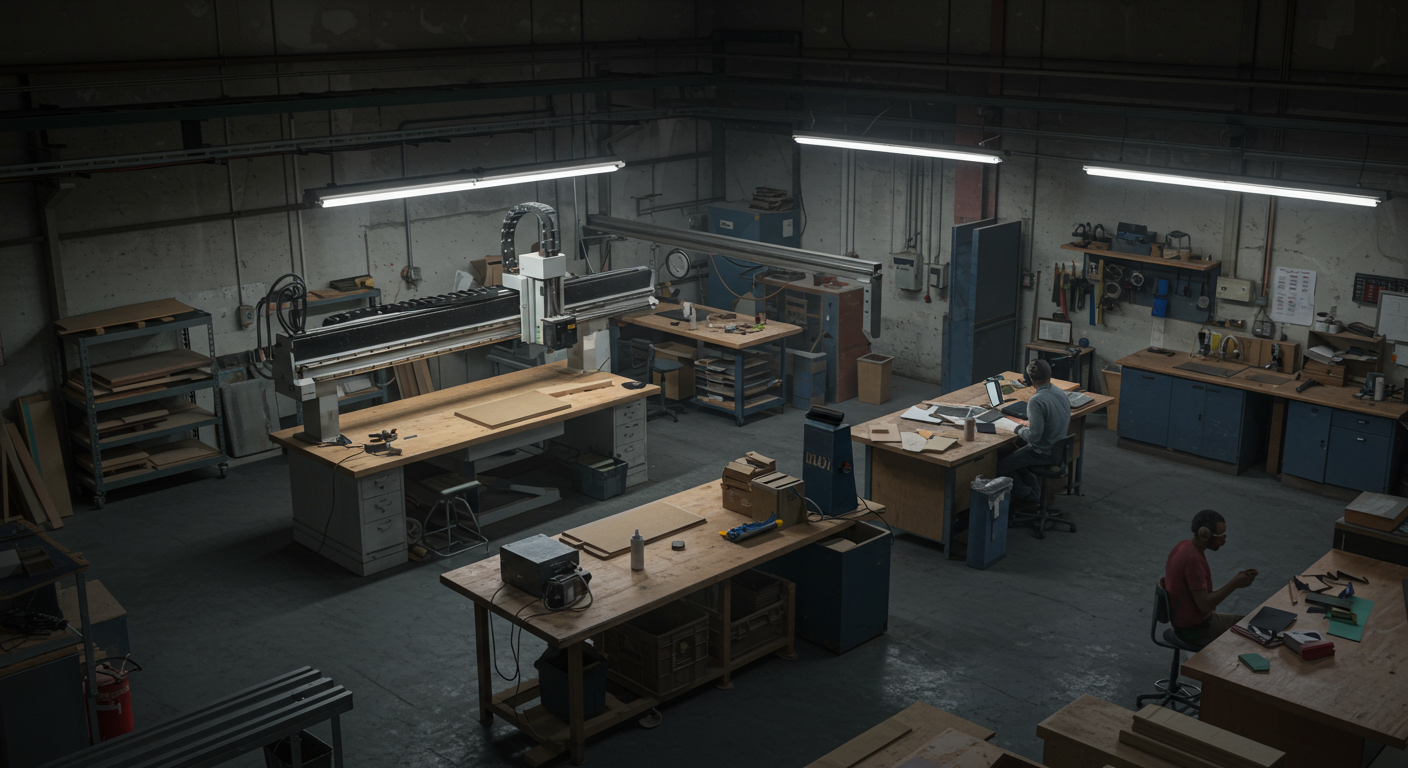
Experiential fabrication is the design, engineering, and construction of custom physical structures and environments for live brand experiences, events, and immersive installations. It encompasses trade show exhibits, pop-up shops, brand activations, stage sets, and interactive environments built to engage audiences through sight, touch, and movement.
The term has evolved significantly over the past decade. What was once called “event carpentry” or “scenic construction” now spans a sophisticated pipeline of digital design, CNC manufacturing, metalwork, scenic painting, large-format printing, and integrated LED lighting. Modern experiential fabrication delivers environments that rival permanent retail and architectural installations — but on event timelines measured in weeks, not years.
This guide breaks down every facet of experiential fabrication: what it includes, how the process works, what it costs, and how to evaluate fabrication partners. Whether you represent a brand, an agency, or an event production team, this is the complete reference for understanding what goes into building the physical world of live experiences.
The Six Core Disciplines of Experiential Fabrication
Professional experiential fabrication shops operate across multiple manufacturing disciplines. Understanding these disciplines helps buyers evaluate whether a fabrication partner can truly deliver an “all in-house” solution or whether they will need to subcontract critical phases of the build.
CNC Routing and Digital Fabrication
Computer Numerical Control (CNC) routing is the backbone of modern fabrication. CNC machines cut precise shapes from sheet materials — plywood, MDF, acrylic, foam, aluminum composite, and HDPE — using computer-controlled router bits. This technology enables intricate logo cutouts, curved wall panels, dimensional lettering, and custom fixtures with tolerances measured in thousandths of an inch.
CNC routing has replaced hand-cutting for most applications because it delivers perfect repeatability. When a brand activation tours to six cities, every unit must match exactly. CNC files ensure that the Austin build is identical to the New York build down to the last millimeter. Advanced shops also use CNC for 3D carving, creating dimensional topographic surfaces, sculpted brand elements, and textured wall panels that add depth to flat surfaces.
Scenic Carpentry and Structural Framing
Scenic carpentry is the structural skeleton of every build. Carpenters construct the frames, platforms, walls, counters, and architectural elements that give an installation its physical form. Unlike residential or commercial carpentry, scenic carpentry prioritizes rapid assembly and disassembly. Structures must be engineered to ship flat, assemble on-site in hours, survive the event, and break down cleanly for storage or the next activation.
Materials include dimensional lumber, steel stud framing, aluminum extrusion systems, and engineered panels. Experienced scenic carpenters understand load calculations for elevated platforms, seismic bracing requirements for trade show floors, and the specific union labor rules that govern installation at major convention centers like the Javits Center in New York or McCormick Place in Chicago.
Metal Fabrication and Welding
Metal fabrication adds structural strength, industrial aesthetics, and permanence to experiential builds. Steel tube framing supports elevated platforms and overhead structures. Aluminum welding creates lightweight arches, gates, and hanging elements that meet rigging weight limits. Stainless steel fabrication produces food-safe counters and bars for hospitality activations.
The choice between steel and aluminum depends on the application. Steel offers superior strength at lower material cost but adds significant weight — critical when shipping builds cross-country or rigging elements overhead. Aluminum costs more per pound but saves substantially on freight and labor. A fabrication shop with in-house welding capabilities can make these decisions in real time, adjusting designs for optimal material selection without waiting on a subcontractor’s quote.
Scenic Painting and Surface Finishing
Scenic painting transforms raw fabrication into finished environments. This discipline covers far more than applying color. Scenic painters create faux finishes that replicate marble, concrete, weathered wood, rust, and brick. They apply gradient color washes across 40-foot walls. They hand-letter signage, age surfaces to look authentically vintage, and create trompe l’oeil effects that make flat panels appear three-dimensional.
Modern scenic painting also includes spray application of specialty coatings: metallic finishes, soft-touch textures, anti-graffiti clear coats for public installations, and fire-retardant treatments required by venue fire marshals. A well-equipped paint shop maintains spray booths with proper ventilation, climate control for consistent drying times, and the space to finish large panels without seam lines.
Large-Format Printing and Graphics
Large-format printing produces the high-resolution graphics that wrap walls, cover floors, and skin structures with branded imagery. Modern UV-cured and latex printers output directly onto rigid substrates (foam board, acrylic, aluminum composite) or onto flexible vinyl and fabric media that get laminated and applied to surfaces.
Print resolution, color matching, and substrate selection all affect the final result. Backlit graphics require different media and ink profiles than front-lit wall wraps. Floor graphics need anti-slip laminate rated for foot traffic. Vehicle wraps demand conformable vinyl that stretches around curves. An in-house print shop eliminates the 3-5 day turnaround of outsourced printing and enables last-minute revisions — a common reality when brand teams finalize creative assets days before installation.
LED Lighting and Technology Integration
LED integration has become standard in experiential fabrication. Programmable LED strip lighting creates backlit brand walls, illuminated shelving, color-changing environments, and dynamic light shows synchronized to music or audience interaction. Direct-view LED video walls display motion graphics and live content at resolutions visible in daylight.
Technology integration extends beyond lighting to include touchscreens, RFID-triggered interactions, projection mapping, motion sensors, and networked content management systems. The fabrication team must collaborate closely with technology vendors or maintain in-house capabilities to ensure that wiring channels, power distribution, data connectivity, and thermal management are engineered into the structure from the design phase — not retrofitted on-site.
How the Experiential Fabrication Process Works
The fabrication process follows a structured pipeline from creative brief to on-site installation. Understanding this pipeline helps brands and agencies set realistic timelines, budgets, and expectations. A typical project spans 6-12 weeks from signed contract to event day, though experienced fabrication teams can compress timelines to 3-4 weeks for simpler builds.
Phase 1: Creative Brief and Concept Development
Every project begins with a creative brief that defines objectives, audience, venue specifications, budget parameters, and timeline. The fabrication partner reviews the brief and responds with initial concepts — typically presented as mood boards, rough sketches, and preliminary 3D renderings. This phase establishes the creative direction and identifies potential engineering challenges before significant resources are committed.
During concept development, experienced fabricators provide critical feedback on buildability. A design that looks stunning in a rendering may be structurally impractical, over budget, or impossible to install within the venue’s load-in window. The best fabrication partners function as creative collaborators, not just builders — they propose alternatives that achieve the design intent within real-world constraints.
Phase 2: Design Engineering and 3D Visualization
Once the concept is approved, the design team produces detailed 3D renderings, engineering drawings, and fabrication plans. Renderings show the client exactly what the finished environment will look like — materials, lighting, graphics, and spatial context. Engineering drawings specify structural connections, material thicknesses, hardware, and assembly sequences.
This phase also includes venue coordination: reviewing floor plans, confirming rigging points, checking power availability, and understanding load-in logistics. For trade shows, this means submitting booth plans to show management for approval. For pop-up shops and brand activations, it means coordinating with venue landlords, local permitting authorities, and fire marshals.
Phase 3: Fabrication and Production
Fabrication is the physical build phase. CNC files are programmed and cut. Carpentry frames go up. Metal is welded. Surfaces are painted. Graphics are printed and applied. LED systems are wired and tested. Each discipline works in sequence and in parallel, with project managers coordinating the flow of components through the shop.
Quality control happens continuously during fabrication. Structures are test-assembled in the shop to verify fit, finish, and alignment before they ship to the venue. Graphics are proofed against brand color standards. Lighting is programmed and tested. This shop assembly — sometimes called a “dry fit” or “pre-build” — is essential for complex installations because it reveals issues that are far easier and cheaper to fix in the shop than on the event floor.
Phase 4: Logistics and Shipping
Fabricated components must be packed, labeled, and shipped to arrive on schedule and in perfect condition. Experienced fabrication shops design builds for efficient packing — structures break down into manageable crates, graphics are rolled or flat-packed with protective interleaving, and hardware is bagged and labeled by assembly section.
Shipping logistics vary dramatically by destination. A local New York City installation may require only a box truck and a loading dock reservation. A Las Vegas trade show shipment involves advance warehouse delivery, drayage coordination with show contractors, and compliance with the convention center’s specific receiving requirements. International shipments add customs documentation, carnet bonds, and extended transit times.
Phase 5: Installation and Strike
Installation — often called “load-in” or “install” — is where the fabrication meets the real world. The install crew assembles structures, applies graphics, connects power and lighting, and addresses the inevitable on-site adjustments that every live event demands. Professional installation crews bring tools, backup materials, and the problem-solving skills to handle venue surprises.
Strike — the disassembly after the event — is equally important. Structures must be carefully disassembled, packed, and either returned to storage for future use or disposed of according to the venue’s waste management requirements. Many brand activation builds are designed for multi-city touring, so strike procedures must preserve components for reassembly at the next venue.
Types of Projects That Require Experiential Fabrication
Experiential fabrication serves a wide range of project types, each with distinct requirements for design, engineering, materials, and installation logistics.
Trade Show Exhibits
Trade show exhibits range from 10×10-foot inline booths to 50×80-foot island exhibits. Custom fabrication is essential for brands that want to stand out on a show floor where hundreds of exhibitors compete for attention. Key considerations include modular design for multiple show configurations, I&D (install and dismantle) efficiency to minimize union labor costs, and durable construction to survive multiple show cycles. Explore trade show fabrication to understand the full scope of custom exhibit construction.
Brand Activations and Product Launches
Brand activations create immersive, interactive experiences that connect consumers directly with a product or brand story. These builds prioritize Instagram-worthy photo moments, tactile engagement, and crowd flow management. Fabrication for activations often includes custom furniture, interactive technology, branded environments, product display systems, and experiential elements like scent diffusion or temperature control.
Pop-Up Shops and Retail Environments
Pop-up shops require retail-grade fabrication that looks permanent but installs and strikes in 1-2 days. This means custom fixtures, point-of-sale integration, merchandise display systems, fitting rooms, and brand environments that meet ADA accessibility requirements. Multi-market touring pop-ups must be engineered for repeated assembly and disassembly without visible wear. Learn more about pop-up shop design and fabrication.
Corporate Events and Conferences
Corporate events require stage sets, keynote backdrops, registration environments, breakout room branding, and wayfinding systems. Fabrication for corporate events emphasizes clean execution, premium finishes, and tight timelines driven by venue availability. Executive presentations demand flawless AV integration, teleprompter sight lines, and lighting that flatters on-camera.
Hospitality and Nightlife Installations
Restaurants, hotels, nightclubs, and bars commission fabricated environments for grand openings, seasonal refreshes, and branded partnerships. These installations must meet health department, fire code, and ADA requirements while delivering the aesthetic impact that drives social media coverage and repeat visits. Pop Up Your Brand has delivered hospitality fabrication projects including the Tao Group x Moxy Hotel installation and the Delilah x Hwood Group buildout.
Stage and Scenic Production
Live events, award shows, concerts, and television productions require scenic fabrication: custom stage decks, set pieces, backdrops, and dimensional scenic elements. Scenic fabrication demands precision engineering for performer safety, quick-change capabilities for multiple scenes, and coordination with lighting and rigging teams. Explore stage and scenic fabrication services.
What Does Experiential Fabrication Cost?
Experiential fabrication costs vary widely based on project scope, complexity, materials, timeline, and venue logistics. No competitor in this industry publishes transparent pricing, which leaves buyers guessing. Here are realistic ranges based on current market rates:
- Small activations and photo moments: $5,000 – $25,000. Single-element installations, branded photo walls, small product displays.
- Mid-scale brand activations: $25,000 – $75,000. Multi-element environments, interactive components, custom lighting, branded furniture.
- Large-scale experiential environments: $75,000 – $200,000+. Full venue transformations, multi-room installations, integrated technology, touring capability.
- Custom trade show exhibits: $30,000 – $300,000+. Dependent on booth size, materials, technology, and number of show cycles.
- Pop-up shop buildouts: $40,000 – $150,000. Retail-grade fixtures, POS integration, merchandise systems, ADA compliance.
These ranges cover design, fabrication, graphics, shipping, and installation. They do not include venue rental, permitting fees, or staffing. Pop Up Your Brand provides detailed, line-item quotes within 48 hours of receiving a brief — an industry-leading turnaround that allows brands and agencies to make budget decisions quickly. Read the full breakdown in the event fabrication cost guide.
How to Evaluate an Experiential Fabrication Partner
Choosing the right fabrication partner is one of the most consequential decisions in event planning. The wrong partner can blow timelines, exceed budgets, and deliver subpar quality that damages brand perception. Here are the criteria that matter most:
In-House Capabilities vs. Subcontracting
The single most important question to ask a fabrication company: what do you build in-house, and what do you subcontract? Every subcontracted discipline introduces schedule risk, communication gaps, and quality inconsistency. A shop that handles CNC, carpentry, metal, paint, print, and LED under one roof controls every variable. A shop that subcontracts three of those six disciplines is a project management firm, not a fabrication shop.
Track Record and Portfolio
Review completed projects similar in scope and complexity to your planned activation. Ask for client references. Look for evidence of on-time delivery — missed deadlines in experiential fabrication are catastrophic because event dates do not move. Pop Up Your Brand has completed over 200 projects with zero missed open dates, a track record that reflects the reliability of a fully in-house fabrication pipeline.
Quote Speed and Transparency
How quickly a fabrication shop returns a quote signals their operational efficiency and commitment to your project. Shops that take 2-3 weeks to quote are either overloaded, disorganized, or both. Expect detailed, line-item quotes — not lump-sum estimates — that break costs into design, materials, labor, graphics, shipping, and installation. This transparency enables informed budget decisions and fair change-order negotiations.
Design Collaboration Capability
The best fabrication partners are design collaborators, not just builders. They should be able to receive a concept sketch, a CAD file, or a napkin drawing and develop it into a buildable, engineered design with realistic 3D renderings. Experiential design capability integrated within the fabrication shop eliminates the communication gaps that occur when designers and builders are separate companies.
Installation and Logistics Experience
Fabrication quality is only as good as the installation. Ask whether the fabrication shop sends its own crew to install or relies on third-party labor. Ask about experience with your specific venue — convention centers, retail spaces, outdoor environments, and hospitality venues each have unique access, timing, and regulatory requirements.
The Future of Experiential Fabrication
Experiential fabrication continues to evolve with technology and audience expectations. Several trends are shaping the industry in 2026 and beyond:
- Sustainable materials and practices: Brands increasingly demand recyclable substrates, low-VOC finishes, and designs that minimize waste. Fabrication shops are investing in CNC nesting optimization, material reclamation programs, and reusable modular systems.
- Digital-physical integration: LED video walls, projection mapping, augmented reality triggers, and interactive touchpoints are standard expectations, not premium add-ons. Fabrication shops must integrate technology from the design phase, not bolt it on after the build.
- Modular and touring systems: Brands want builds that tour to multiple markets, reconfigure for different venue footprints, and evolve across campaign phases. This demands modular engineering that balances visual impact with logistical efficiency.
- Speed and agility: Campaign timelines are compressing. Brands that once planned 16 weeks ahead now expect 6-8 week turnarounds. Fabrication shops with fully integrated in-house capabilities have a structural advantage because they eliminate the coordination delays inherent in subcontracted workflows.
- Data-informed design: Post-event analytics — foot traffic patterns, dwell times, social impressions — increasingly inform the design of subsequent activations. Fabrication partners that understand these metrics can optimize spatial layouts and interactive elements for measurable engagement.
Key Takeaways
Experiential fabrication is a multi-discipline manufacturing process that creates the physical environments where brands connect with live audiences. It spans CNC routing, scenic carpentry, metal fabrication, scenic painting, large-format printing, and LED integration. The process moves from creative brief through design engineering, shop fabrication, logistics, installation, and strike.
Success depends on choosing a fabrication partner with genuine in-house capabilities, a proven track record of on-time delivery, transparent pricing, and the design collaboration skills to translate creative vision into buildable reality. Pop Up Your Brand operates all six fabrication disciplines in-house from a New York City shop, delivers 48-hour quotes, and maintains a record of over 200 projects with zero missed event open dates.
Ready to discuss your next experiential project? Request a quote and receive a detailed proposal within 48 hours.
Frequently Asked Questions About Experiential Fabrication
Experiential fabrication is the physical construction of custom structures, environments, and installations for live events. Event production encompasses the broader scope of planning, logistics, staffing, AV, catering, and programming. Fabrication is one component within event production — the discipline responsible for building the physical environment that audiences see and interact with. Many event producers subcontract fabrication to specialized shops.
Typical experiential fabrication timelines range from 4 to 12 weeks, depending on project complexity, materials, and scope. Simple single-element builds can be completed in 3-4 weeks. Multi-element brand activations and custom trade show exhibits typically require 6-10 weeks. Large-scale immersive environments and touring installations may need 10-16 weeks from design approval to installation day.
Common materials include plywood, MDF, and hardwoods for structural carpentry; steel tube and aluminum extrusion for metal framing; acrylic, polycarbonate, and HDPE for dimensional elements; foam for sculpted features; vinyl and fabric for printed graphics; and LED strip, panel, and video wall systems for lighting and display. Material selection depends on structural requirements, aesthetic goals, weight limits, fire code compliance, and budget.
Reusable builds are standard practice for brands with recurring event calendars. Modular fabrication systems allow structures to be disassembled, stored, and reassembled at future events. Touring activations are specifically engineered for repeated assembly and disassembly — typically 6-12 deployments — using durable materials, quick-connect hardware, and case-packed shipping solutions. Reuse reduces per-event costs significantly after the initial investment.
Event producers excel at logistics, programming, and vendor coordination but rarely operate fabrication shops. Custom structural builds, CNC-routed elements, metal fabrication, scenic painting, and integrated LED lighting require specialized equipment and skilled tradespeople. For projects beyond pipe-and-drape or rented modular systems, a dedicated fabrication partner delivers higher quality, more creative possibilities, and better cost control than general event producers attempting to self-build.
Ready to build something extraordinary?
Get a detailed, line-item quote within 48 hours. Design, fabrication, and installation — all in-house.
Start Your Project