Oct 23, 2026 · Trade Shows & Exhibits
Building a Trade Show Booth for Los Angeles: The LACC Guide
A builder's guide to LACC: what each hall allows, the fire rules your booth must pass, California flame-retardant registration, and how a booth built in New York reaches a Los Angeles dock on time.
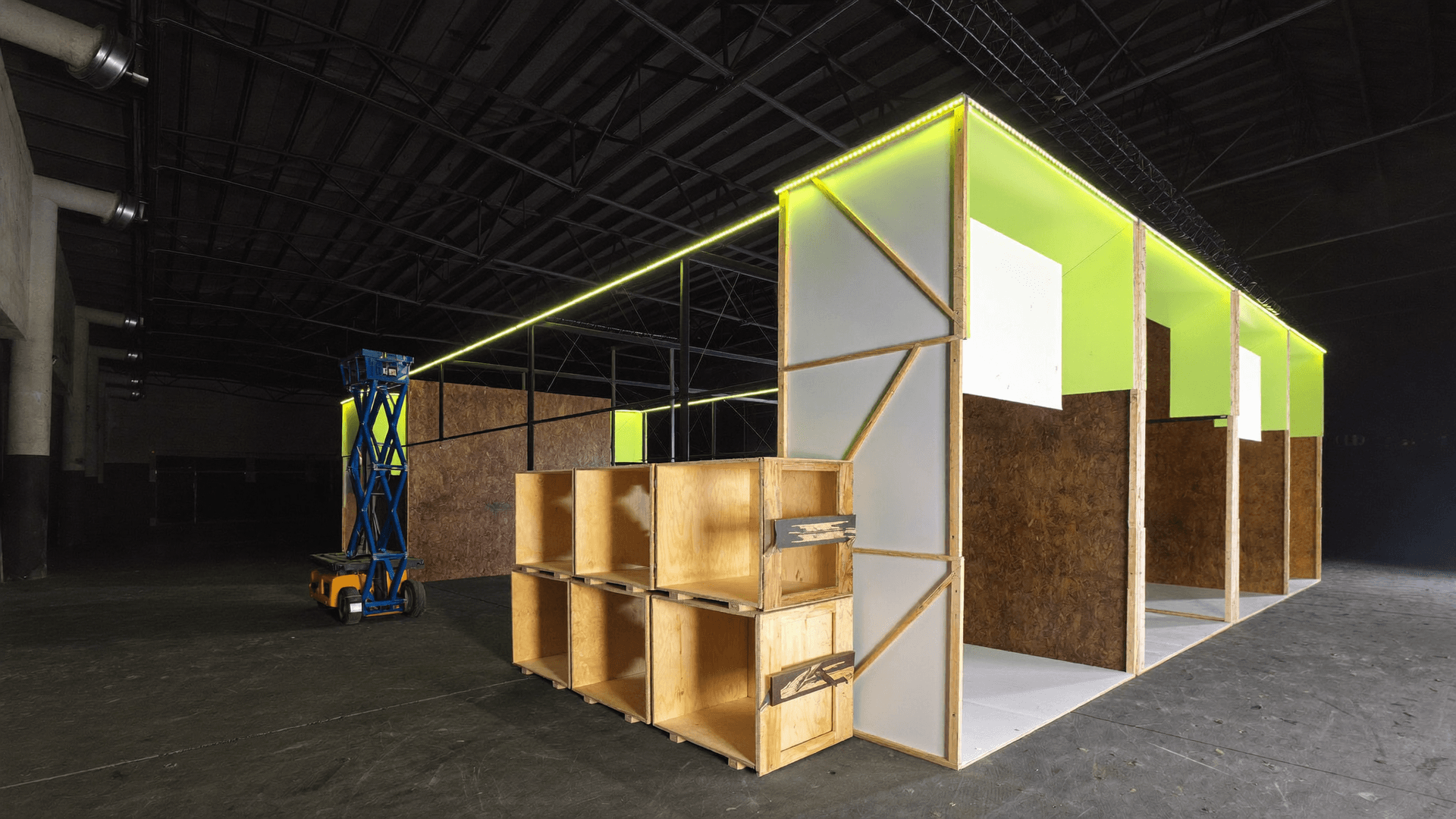
The show is on the calendar, the render is approved, and the booth will be built about 2,800 road miles from the hall it opens in. If you are planning a trade show booth in Los Angeles with a New York fabricator, three things decide whether it opens clean: the Los Angeles Convention Center (LACC) fire marshal, California's flame-retardant paperwork, and the freight calendar. Miss any one of them and the problem shows up at load-in, when it costs the most to fix.
This guide is for exhibitors who already know how a booth gets built and want the LA-specific details: what each LACC hall allows, what the fire rules require, which certificates California asks for, and how a booth built in our New York shop gets to a Downtown LA dock on time. For the wider picture of how we deliver on the West Coast, see our page on event fabrication in Los Angeles.
What does it take to build a trade show booth for Los Angeles?
Building a trade show booth for Los Angeles from New York takes four things: a booth engineered to travel, a fire permit request filed with the LACC fire marshal at least 21 days before the event, California-registered flame-retardant materials, and eight to ten weeks of lead time from booking to opening day.
None of that is exotic. It is the same discipline as a Javits build, with a longer truck ride and a different set of forms. Where out-of-town builds go wrong is in assuming the New York paperwork carries over. It doesn't. California has its own state registry for flame-retardant fabrics and treatments, LACC runs its own fire life safety guidelines, and every show at the building publishes its own exhibitor manual with its own deadlines.
The upside of building in New York is control. Every wall, counter and hanging sign is built, finished and dry-fit in one shop before it ships. On the floor, the crew is assembling, not solving problems.
Which LACC hall are you in, and what does it let you build?
The hall sets your structural limits before the designer draws a line. LACC's exhibit space is spread across three main halls, and they are not interchangeable. Ceiling height decides hanging signs and double-decks. Floor load decides heavy product and water features. Columns decide where an island can sit.
| Hall | Exhibit area | Capacity (10x10 booths) | Ceiling | Floor load | Build notes |
|---|---|---|---|---|---|
| South Hall | Nearly 350,000 sq ft | 1,720 | Varies by section; take it from the show's floor plan | 350 lbs/sq ft | Virtually column-free; divisible into up to three spaces |
| West Hall | 210,685 sq ft | 1,050 | 36 ft | 300 lbs/sq ft | Virtually column-free; height for tall hanging signs and double-deck structures |
| Kentia Hall | About 160,000 sq ft | 844 | 18 ft minimum | Listed as unlimited | 30 in columns on 30 ft centers; plan island footprints around them |
What the numbers mean for the design
A 36 ft ceiling in West Hall leaves real room for a rigged sign over an island, once you subtract the show's own height limit, which is almost always lower than the building. In Kentia, an 18 ft minimum ceiling and a 30 ft column grid change the plan. A 20x30 island can land on a column, so the drawings need the column locations from the floor plan before the structure is final. If you are weighing a second level, our guide to double-deck booth builds covers the engineering and approval steps.
Overhead light in convention halls is flat and bright, which is why lit graphics and fixtures carry so much of the booth's presence. LED lighting integration belongs in the first drawing set, not in a late change order. Power runs and drivers have to be engineered into walls that will be crated and rebuilt.
What fire rules does an LACC booth have to pass?
The LACC Fire Life Safety Guidelines set the floor rules, and the Los Angeles Fire Department (LAFD) enforces them. The short version: larger or more complex booths submit plans, covered booths need detection or sprinklers depending on size, permit requests are due 21 days out, and nothing gets a variance without written approval from the LACC Fire Marshal.
What the guidelines require, in the order a fabricator designs to them. Show management distributes the current edition with the exhibitor manual, so check each figure against the copy for your show:
- Plan submission. Exhibits of 400 sq ft or larger, or with closed rooms, multiple levels or moving parts, submit two sets of plans. A 20x20 island is exactly 400 sq ft, so most islands are in.
- Permit timing. Fire permit requests are due 21 days before the event. Work backward from that date, not from the ship date.
- Covered booths of 100 to 750 sq ft. An enclosed or covered booth in this range needs an internal smoke detector with a local alarm. A meeting room with a ceiling counts.
- Covered booths over 750 sq ft. In West Hall AB, South Hall G to K, or Kentia, these need an LAFD-approved sprinkler system under a Department of Building and Safety permit. That is a cost and schedule item, so decide early whether the roof is worth it.
- Variances. None without written approval from the LACC Fire Marshal. A verbal yes on the floor is not approval.
The plans the fire marshal reviews are the shop's drawings, so their quality matters. Our fabrication drawings the fire marshal can review show dimensions, exits, ceiling coverage, materials and detector locations on the same sheets the shop builds from. Requirements change between editions, so confirm every item with the LACC fire marshal and your show's current exhibitor manual.
What is different about California flame-retardant certification?
California runs its own registration program. The Office of the State Fire Marshal (OSFM) registers flame-retardant chemicals, the applicators who treat materials, and treated fabrics, under Title 19 of the California Code of Regulations. OSFM's authority reaches trade show display equipment. Registered products carry the State Fire Marshal seal with a registration number.
For a New York build, the change is in sourcing. A fabric that passes the test you usually run may still lack California registration. The fix is cheap if it happens at the drawing stage and painful if it happens at the dock:
- Specify registered fabrics and registered treatments on the drawings, with the registration numbers in the material schedule.
- Order printed graphics on registered substrates. SEG fabric, backlit tension graphics and soft-goods walls are where most booths carry the most fabric.
- Keep certificates and the seal documentation in the booth binder that travels in the crate, and a digital copy with the show manager.
- Ask the show's fire marshal before you substitute a material, even one that looks identical.
Printing graphics under the same roof as the build keeps this simple. With in-house large format printing, the substrate, the certificate and the finished panel come from one source. Nobody has to chase a print vendor for paperwork in the week the crates ship. This is general guidance, not legal advice; the fire marshal for your show has the final word.
Who is allowed to build your booth on the LACC floor?
Three parties share the floor. The official show contractor moves freight from the dock to your booth space and back. Installation and dismantle run under local union jurisdiction. Your fabricator works as an exhibitor-appointed contractor (EAC), registered with show management under the rules in the exhibitor manual.
For an out-of-town shop, that means our crew flies in, supervises and works alongside local labor, and leads the build from the drawings. The rules on who may handle tools, ladders and power vary by show and by trade, so read the labor section of the manual before you budget crew hours.
The paperwork follows a familiar pattern: an EAC notification form, a certificate of insurance naming the right parties, and crew badge requests, each with its own deadline. If you have exhibited at the Javits, our NYC convention center load-in guide walks through how those forms work. LA uses the same structure with different dates and contacts.
How does a booth built in New York get to LACC, and how long does it take?
Cross-country freight takes four to five days. The booth leaves our New York shop crated and labeled, travels by dedicated truck, and checks in through the show's freight process, which is often a marshaling yard before the docks. Anime Expo 2026 at LACC is a good example: its exhibitor information page (updated May 26, 2026) required every show-site delivery to check in at a marshaling yard on East 7th Street first, set a hard driver check-in deadline, and warned that ongoing construction at LACC would limit dock access. Yards, windows and target move-in times vary by show, so take them from your manual.
Engineering for the trip
A booth that travels 2,800 miles is designed differently from one that crosses the Hudson. Panels are sized to the crate, not the other way around. Connections are repeatable, so the wall that went up in the shop goes up the same way on the floor. Finishes are protected at every contact point. Modular booth systems built to travel do this by design, which is why they shorten LA schedules. Crating and freight are also where the show bill grows; our breakdown of drayage and crating costs explains how weight drives the invoice.
| Stage | When | What happens |
|---|---|---|
| Booking | 8 to 10 weeks out (5 to 6 for modular rush) | Scope, floor plan, exhibitor manual in hand |
| Design lock | Typically 8 weeks out | Drawings approved; plan set started if 400 sq ft or larger |
| Registered materials ordered | Typically 6 weeks out | California-registered fabrics and substrates ordered; certificates collected |
| Shop build and dry fit | Typically 6 to 3 weeks out | Full build, finish, graphics and power tested in the shop |
| Fire permit request | At least 21 days before the event | Filed per the LACC Fire Life Safety Guidelines; EAC form and insurance certificate filed per the manual |
| Crate and ship | Typically 2 weeks out | Crates loaded; 4 to 5 days in transit |
| Marshaling and install | Show move-in | Check-in, dock, assembly with local labor |
Has a New York shop built a cross-country convention booth on a tight clock?
Yes, and the closest example is in California. Our Café de Colombia build at the San Diego Convention Center was an 800 sq ft, 40x20 footprint designed to read as a permanent specialty coffee shop. It had a retail-spec service bar, two tasting zones and a concealed back-of-house wall. The schedule was 14 days from drawings to install. Fabrication, finish and graphics ran in parallel, and the crating manifest was built backward from the convention center's load-in window. More than 3,000 attendees came through over the three-day run.
Fourteen days from drawings to install, executed end-to-end out of our NYC shop, crated cross-country, and stood up in one load-in day.
The same method works on the largest floors. The Thermacell island booth at IBS was a 20x30 island at the Las Vegas Convention Center with a welded steel canopy for the hanging sign, a semi-private meeting room and backlit fabric graphics. It was pre-assembled in our New York shop, broken down into labeled crates, and installed with local union labor inside the allocated 8-hour window. Its connection system lets it reconfigure to a 20x20 island or a 10x20 inline, and it has been used across three shows.
Custom, modular or hybrid: which booth makes sense for an LA show?
When freight is the biggest variable, booth type is a budget decision as much as a design one. A fully custom build gives the most presence and the heaviest crates. A modular system ships light and goes up fast. A hybrid puts a custom hero element, such as a counter, logo wall or hanging sign, on a modular frame.
| Custom | Modular | Hybrid | |
|---|---|---|---|
| Freight weight | Highest | Lowest | Moderate |
| Crate count | Highest | Lowest | Moderate |
| Install hours | Longest | Shortest | Short to moderate |
| Reuse across NYC, Vegas and LA | Possible if engineered for it | Built for it | Frame reused; hero element refreshed |
| Brand presence | Highest | Depends on graphics | High where it counts |
For bicoastal programs we usually recommend the hybrid. The frame travels and reconfigures; the custom piece carries the brand. Where the design is locked and presence is the point, full custom exhibit design is worth the freight. Our Netflix booth at the Meadowlands shows what a render-locked custom build takes: a 22x22 footprint with flush-mount TVs set to bezel depth and a color-matched LED logo, built and dry-fit in two weeks on a scope that normally runs four to six.
What should you do, and when, before an LA show?
Count back from move-in. The fixed points are the 21-day fire permit deadline and four to five days of freight. Everything else is set by your show's manual and the booth's complexity. The checklist below follows the same schedule as the timeline table above.
- 10 to 8 weeks out: book the fabricator, download the exhibitor manual, get the floor plan with column and ceiling data for your space.
- 8 weeks out: lock the design, including the build type; our comparison of custom vs modular booths covers the trade-offs. If the booth is 400 sq ft or larger, or has a closed room, second level or moving parts, start the plan set.
- 6 weeks out: order California-registered fabrics and graphic substrates, then start the shop build. Collect certificates as they arrive.
- 3 weeks out: fire permit request in (at least 21 days before the event). EAC form and certificate of insurance filed per the manual. Dry fit complete.
- 2 weeks out: crates ship from New York. Confirm marshaling yard instructions and your target move-in time.
- Show week: crew flies in, checks freight, builds with local labor, walks the booth with the fire marshal if required.
If the LA show is one stop in a season, plan it as part of the program rather than a one-off. Our guide to multi-city trade show programs covers storage, refresh cycles and how one booth serves several cities.
Start your LA booth quote
Send us the show name, your hall, the booth size and a render or sketch. You will get a line-item quote within 48 hours that covers design, drawings, shop build, crating, freight and install. Every booth is built and dry-fit in our New York shop before it ships, so the build on the LACC floor matches the one we already signed off.
Start with our custom trade show fabrication team and tell us when your show moves in.